- Share
-

-

This is the work of renewal visibility, and getting it right in your CRM is the single biggest win most RevOps teams are still missing. The hidden cost isn't the churned logo you saw coming and couldn't save. It's the ones you never saw at all, plus the expansion you never captured. Let's break down why the blind spot exists, what it's costing you, and how to fix it inside HubSpot.
Why Renewals Are the Blind Spot in Most HubSpot Instances
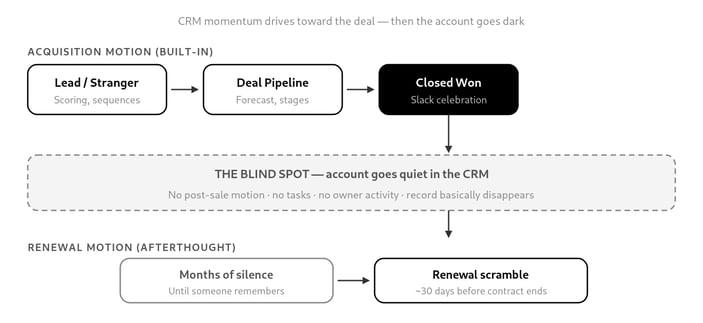
HubSpot, like nearly every CRM, was built to acquire customers. Deal pipelines, lead scoring, sequences, and forecast tools all point in one direction: turn a stranger into a signed contract. The post-sale motion got bolted on later, if at all. So when a company closes a deal, the record often goes quiet. The Deal moves to Closed Won, the celebration Slack message fires, and the account basically disappears from the CRM until someone remembers it 30 days before renewal.
That built-in bias is why renewal visibility CRM problems are so common. The contract end date lives in a signed PDF in a legal folder. Product usage lives in the app database. Billing status lives in Stripe or NetSuite. Customer sentiment lives in the CS rep's head. None of it is in the CRM where the revenue work actually happens. That means none of it can trigger a workflow, fill a forecast, or fire an alert. The data exists. It's just scattered across four systems that don't talk to each other, and the CRM, the one system that should pull them together, sees almost none of it.
The cost of this mess adds up. Look at the benchmarks. It costs 5 to 7 times more to acquire a new customer than to keep one [2], so renewal leakage is the most expensive leakage there is. The best SaaS companies run Net Revenue Retention above 120%, while the B2B median sits at 100 to 106% [3]. The gap between those numbers is almost never a product problem. It's a visibility problem. And when Gross Revenue Retention drops below 90% in mid-market, that's not bad luck [4]. That's a broken renewal process hiding in plain sight.
The Four Data Pillars of Renewal Visibility
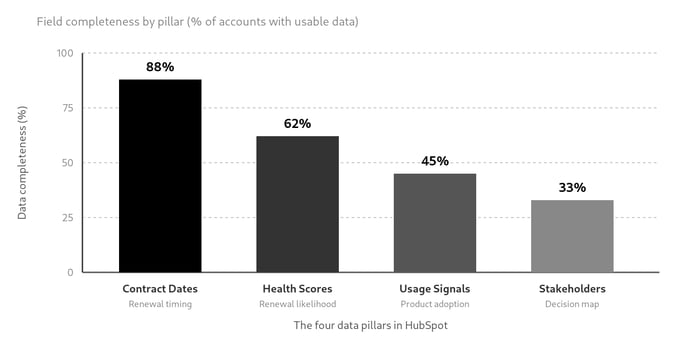
Real renewal visibility rests on four data pillars. Miss any one and the whole thing wobbles. Each pillar answers a specific question, and each has a clear home inside HubSpot.
1. Contract dates. When does this account come up for renewal, and on what terms? If the Renewal Date isn't a filled-in, searchable date property on the record, it can't be automated, alerted, or forecasted. This is the must-have foundation. Everything else depends on it.
2. Health scores. How likely is this account to renew, churn, or expand? Health has to be a field, not a feeling. A calculated health score turns "I think ACME's fine" into a clear, ranked signal you can act on.
3. Product usage. Is the customer actually getting value? Usage is the earliest and most honest churn and expansion signal you have. A login trend, a feature adoption rate, a seat-use percentage, these predict outcomes months before a renewal talk.
4. Billing data. What is this account actually paying, and is that number moving? MRR, ARR, downgrades, and payment status must be visible on the Company record. That way you catch shrinking revenue the moment it happens, not weeks later when Finance mentions it in passing.
Here's how these pillars break in the real world. Take the Silent Churn. A $48K ARR account renews on autopilot for two years. In year three the champion leaves, product logins drop 60%, and two support tickets go unsolved. Nobody was watching usage. The renewal notice hits Finance 15 days before expiry, way too late to run a save play. The account churns. Every warning sign was there. None of it was in the CRM. That's not a bad account. That's a broken system.
How Missing Contract Dates Silently Destroy Your Forecast
Of the four pillars, contract dates are where I start every project. Their absence is both the most common failure and the most damaging. If the renewal date isn't a structured property in HubSpot, your renewal motion is running blind. You can't build a workflow off a PDF. You can't forecast off a date buried in someone's inbox.
This is exactly how the Forecast Miss happens. A CRO tells the board they'll hit $12M. That number is built on new-business pipeline plus an unspoken guess that renewals "just happen." Q4 lands at $10.4M. Why? Because $1.6M in renewals slipped, downgraded, or churned, and none of it was forecasted, because the renewal deals were never created in a pipeline in the first place. The CRO wasn't lying to the board. The CRO simply couldn't see 80% of the revenue base.
The fix in HubSpot is structural. Store contract data on a dedicated Contract or Subscription object, either HubSpot's native Commerce subscriptions or a Custom Object, and capture contract start date, end date, term length, and renewal type (auto versus manual). Then standardize the properties that make renewals actionable: Renewal Date, Renewal ARR, Auto-renewal (boolean), Health Score, and Renewal Owner. Once those exist and are filled in, the CRM can finally do its job. It automates a motion instead of documenting a disaster after the fact.
Health Scoring: Turning "Gut Feel" Into a Revenue Signal
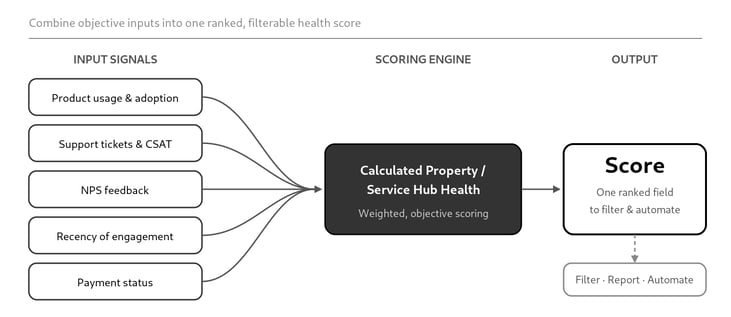
"How's the ACME account?" is a question that should get a number, not a shrug. A customer health score is what turns scattered signals into one ranked field you can filter, report on, and automate against.
To build one that actually predicts outcomes in HubSpot, combine objective inputs using calculated properties or Service Hub's native Customer Health scoring. Use product usage and adoption trends, support ticket volume and CSAT, NPS, how recently they engaged, and payment status. The more objective the inputs, the more the score predicts the future instead of just echoing a rep's optimism. A health score built on "the CS rep's confidence" is just a feeling dressed up as a number.
The payoff works two ways. On defense, a health-based alert workflow fires a task to the CS owner the moment a score drops below your threshold. An at-risk escalation workflow then routes red-health, high-ARR accounts straight to leadership while there's still time to act. On offense, health scoring surfaces expansion. Remember the Missed Expansion. An account running at 95% of its seat allocation and hitting usage caps every month is a textbook upsell. But if usage data never reaches HubSpot, the CS rep never sees it, and the customer eventually takes that need to a competitor. Health scoring built on real usage catches both the risk and the opportunity.
When Billing and CRM Don't Talk, Finance and CS Fight
The gap between billing and CRM isn't just a data problem. It's an organizational one. Finance knows the moment an account downgrades or misses a payment. The CS rep managing that relationship finds out weeks later, often from the customer. In the meantime, contraction MRR goes untracked, the forecast drifts from reality, and two teams that should be aligned end up pointing fingers over whose number is right.
Closing this gap is a simple integration play. Sync your billing system, whether that's Stripe, Chargebee, NetSuite, or QuickBooks, into HubSpot so MRR, ARR, downgrades, and payment status show up right on the Company record. Now the CS rep and the CFO work from the same source of truth. Shrinking revenue becomes visible as it happens, not as a quarter-end surprise. And because billing data feeds the health score, a missed payment or a downgrade automatically drags an account's health down and triggers the same alerts that protect against churn.
Building a Renewal Pipeline That Feeds an Accurate Forecast
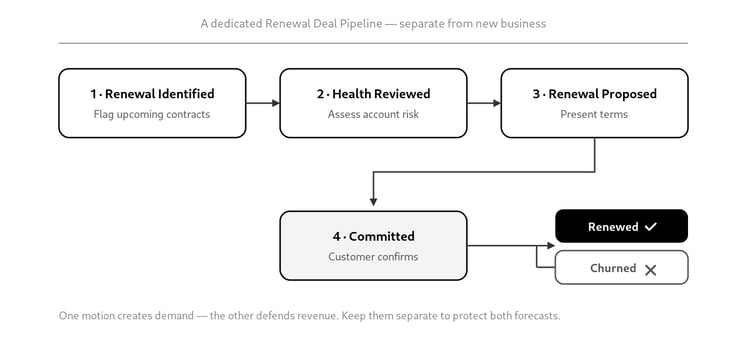
All four pillars come together in one place: a dedicated Renewal Deal Pipeline, kept separate from your new-business pipeline. This is where renewal visibility becomes real work. The stages reflect the actual renewal motion, for example: Renewal Identified, Health Reviewed, Renewal Proposed, Committed, and Renewed or Churned. Mixing renewals into your new-business pipeline pollutes both forecasts, because the motions are so different. One is about creating demand. The other is about defending and growing a relationship you already have.
The engine that makes this work is automated renewal deal creation. Build a workflow that creates a renewal deal a set number of days before the contract end date. I recommend 120 days for enterprise, 90 for mid-market, and 60 for transactional SMB. This makes sure the renewal shows up in the pipeline early enough to actually change the outcome, instead of appearing as a fire drill two weeks out.
Once renewals live in their own pipeline with filled-in dates, ARR, and health scores, your reporting changes for the better. Build a Renewal Forecast dashboard showing renewals by month, weighted by health score. Add true NRR and GRR reporting based on deal-level revenue movements: renewal, expansion, contraction, and churn. Track renewal pipeline coverage so you know whether enough renewal ARR is staged to hit the number. Suddenly the CRO can walk into the board meeting and speak to 100% of the revenue base, not just the shiny new-logo third of it.
The RevOps Playbook: Assigning Ownership Across Sales, CS, and Finance
Systems don't run themselves. People do. The most common reason a renewal motion falls apart is confusion over who owns it. When it's unclear whether renewals belong to CS, Sales, or Finance, renewal deals don't get created, don't get worked, and don't get forecasted until they've already lapsed.
Build accountability right into HubSpot with a Renewal Owner property on every account, and spell out the handoffs. Here's a common model that works: CS owns health and the flat renewal, Sales owns expansion and complex negotiations, and Finance owns the billing sync and contraction reporting. The exact split matters less than this: the system enforces it. Every renewal deal has a named owner, every red-health account has an escalation path, and every stage change is logged. Ownership you can't see in the CRM is ownership that doesn't exist.
Frequently Asked Questions:
Should renewals be tracked in the same pipeline as new business?
No. Keep them separate. New business and renewals are very different motions. One creates demand, the other defends and grows a relationship you already have. Separate pipelines keep your forecasts clean, let you report NRR and GRR accurately, and stop renewal deals from skewing your new-business conversion numbers.
How far in advance should a renewal deal be created in HubSpot?
It depends on deal size and complexity. Use an automated workflow tied to the contract end date: 120 days out for enterprise, 90 days for mid-market, and 60 days for transactional SMB. The goal is to create the renewal deal early enough that your team can review health, run a save play if needed, and negotiate expansion, instead of scrambling in the final two weeks.
What data do I actually need to build a customer health score in HubSpot?
Focus on objective signals: product usage and adoption trends, support ticket volume and CSAT, NPS, how recently they engaged, and payment status. The more objective the inputs, the more your score predicts churn and expansion instead of just echoing a rep's optimism. Build it with calculated properties or Service Hub's native Customer Health scoring.
Do I need Revenue Hub or Service Hub to get renewal visibility?
No. You can build most of this with core HubSpot objects, custom properties, and workflows. That said, Service Hub adds native health scoring and Commerce Hub adds subscription management, so those tiers speed up the build. The pillars matter more than the license level.
Conclusion
Poor renewal visibility doesn't announce itself. There's no alarm when a renewal date sits trapped in a PDF. There's no error message when a forecast quietly assumes renewals will "just happen." The cost builds up silently: in the churned account you never saw coming, the shrinking revenue Finance found before CS did, the expansion a competitor grabbed because your usage data never reached the CRM. By the time it shows up in your NRR, the damage is already booked.
The fix isn't heroic. It's structural. Get the four pillars, contract dates, health scores, product usage, and billing data, into HubSpot where your teams actually work. Stand up a dedicated renewal pipeline, automate deal creation off contract dates, weight your forecast by health, and assign clear ownership across Sales, CS, and Finance. None of this needs a platform migration or a six-figure tool. It needs you to treat the 80% of your revenue that comes from existing customers with the same care you already give new logos.
Strong renewal visibility in your CRM is the difference between a forecast you defend to the board and one you apologize for. It's the difference between median NRR and best-in-class. And in a market where retention is 5 to 7 times cheaper than acquisition [2], it's the highest-return work your RevOps team can do this quarter. Start by pulling that renewal report. What you can't see is exactly what's costing you.
References
- Bain & Company, "The Economics of Recurring Revenue in B2B SaaS," 2023.
- Harvard Business Review, "The Value of Keeping the Right Customers," 2022.
- KeyBanc Capital Markets, "SaaS Metrics Survey: Net Revenue Retention Benchmarks," 2023.
- SaaS Capital, "Gross Revenue Retention Benchmarks for Private SaaS Companies," 2023.
- HubSpot, "Customer Health Scoring in Service Hub: Product Documentation," 2024.