- Share
-

-

Why Finance Doesn't Trust Your CRM (And Why They're Right)
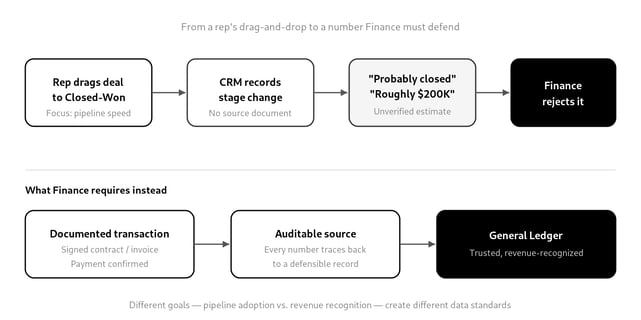
Finance runs on a simple rule: every number must trace back to a source you can defend. The general ledger doesn't have "probably closed" or "roughly $200K." It has documented, auditable transactions. Your CRM, on the other hand, was set up by people focused on pipeline speed and rep adoption, not revenue recognition. Those are different goals, and they lead to different data standards.
Think about what happens at a typical stage change. A rep drags a deal to closed-won. HubSpot records a deal amount and a close date. But which amount? Sometimes it's the first-year value. Sometimes it's the full contract value across three years. Sometimes it includes a one-time setup fee, sometimes not. The close date shows when the rep updated the record, not when the customer signed or when revenue starts. None of this matters for a commission run. All of it matters when Finance tries to tie that deal to an invoice.
The reconciliation headache above is the predictable result. When a $450K three-year deal with rising pricing ($100K, $150K, $200K) gets booked as a single $450K figure, it breaks ARR reporting (which year's ARR is that?) and the revenue recognition schedule at the same time. Finance can't defend a number the CRM can't produce cleanly. They're not being difficult. They're being right.
The Customer Journey Is a Revenue Artifact, Not a Sales Funnel
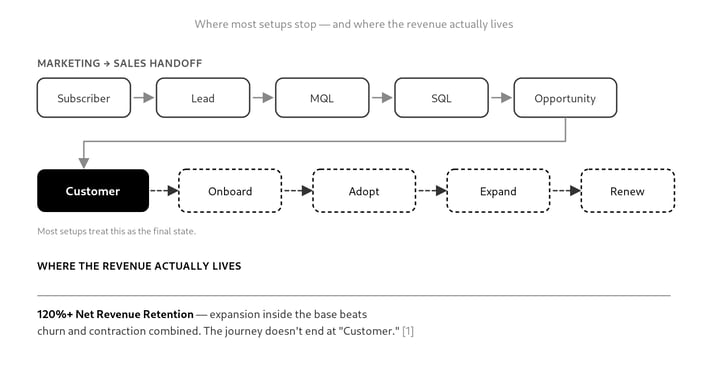
Most HubSpot setups treat the customer journey as a marketing-to-sales handoff. Lifecycle stages march from Subscriber to Lead to MQL to SQL to Opportunity to Customer, and then they stop. The word "Customer" becomes the final state. But in a subscription business, that's where most of your revenue actually lives.
Top-quartile SaaS companies hit 120%+ Net Revenue Retention, which means expansion inside the existing base beats churn and contraction combined [1]. If your journey ends at "Customer," you've built a system that goes blind right where 70 to 80% of revenue movement happens [2]. It costs 5 to 7 times more to win a new customer than to keep one [3], yet the post-sale journey is almost always the least-governed part of the CRM.
Rethinking the customer journey revenue operations model means seeing that onboarding, active, at-risk, renewed, expanded, and churned are not soft "customer success" states. They are financial states. Each one maps to recognized revenue, deferred revenue, or lost revenue. When you build the journey around those facts, the CRM stops being a sales tool Finance puts up with. It becomes the upstream source of truth for what gets billed, forecasted, and recognized.
Designing Lifecycle Stages That Map to Recognizable Revenue
The instinct is to stretch HubSpot's Lifecycle Stage property with a dozen post-sale stages: Onboarding, Active, At-Risk, Renewed, Churned. Don't do it. Lifecycle Stage is a one-directional property tied deeply to marketing and sales reporting, list logic, and attribution. Cramming post-sale states into it creates chaos. A customer who churns and then wins back breaks the linear model, and your funnel conversion reports become useless.
Instead, keep Lifecycle Stage lean and show the post-sale journey in two ways:
- A custom "Customer Status" or "Customer Health" property on the Company record for the current state: Onboarding, Healthy, At-Risk, Churned. This is your operational signal, updated by CS activity and product usage.
- Custom Objects for Subscriptions, Contracts, and Renewals for the financial backbone. These records live on their own, apart from any sales deal. A subscription has a start date, an end date, an ARR value, and a billing frequency. It stays true even after the deal that created it closed long ago.
This split is the single most important design choice in the whole build. Deals represent sales events. Custom objects represent revenue that lasts. When you connect a Subscription custom object to both the Company and the original Deal, Finance can ask "what is this customer's current ARR?" and get an answer that doesn't depend on a rep updating a deal field correctly eighteen months ago.
Governing Deal Data So It Reconciles to Billing
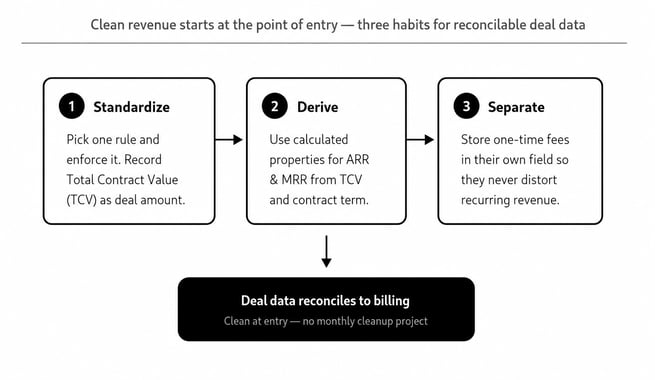
Clean revenue data starts at the point of entry, not in a monthly cleanup project. Three habits make deal data reconcilable:
Standardize what the amount means. Pick one rule and enforce it. I suggest recording Total Contract Value (TCV) as the deal amount, then using calculated properties to derive Annual Recurring Revenue (ARR) and Monthly Recurring Revenue (MRR) from TCV and the contract term. Store one-time fees in a separate property so they never mess up your recurring revenue math. When a rep enters a three-year, $450K ramp deal, the term and start date drive the ARR schedule instead of one misleading number.
Govern the close date. Close date is not "when I remembered to update the deal." Define it as the date the customer contractually committed, meaning the signature date. Then use Forecast Category (Commit, Best Case, Pipeline, Omitted) so weighted pipeline reflects real confidence, not rep optimism. A healthy pipeline coverage ratio of 3 to 4 times the target [4] means nothing if close dates slip freely and stages don't match reality.
Require key properties on stage changes. HubSpot lets you require specific properties before a deal can move to a stage. Use it hard. A deal cannot reach closed-won without a signed contract date, a standardized amount, a contract term, and a link to the Company. Pair this with data-quality workflows that flag any deal missing a close date, amount, or association. Use HubSpot's Data Quality tools to catch duplicates and formatting problems before they reach a report.
Building Renewals Into the System, Not the Spreadsheet
The phantom renewal is the scenario that keeps CROs up at night. A $180K account auto-churns because the renewal date lived in a CSM's spreadsheet instead of a governed record. No workflow fired. No task was created. The first sign of trouble was a missed invoice. That's not a discipline failure by the CSM. It's an architecture failure by RevOps.
The fix is structural. Run renewals on a separate deal pipeline from new business, with its own stages (Upcoming, In Negotiation, Renewed, Churned, Downgraded) and its own forecast categories. Then use a workflow that reads the end date on the Subscription or Contract custom object and automatically creates a renewal deal 90 to 120 days before contract end, assigns it to the owning CSM, sets a close date matching the renewal date, and fills in the amount from the existing subscription ARR.
Now retention gets tracked the same way new business does, as a governed deal with a stage, an amount, a close date, and a forecast category. This is what makes Gross Revenue Retention and Net Revenue Retention something you can calculate in real time instead of rebuilding by hand every quarter. When GRR dips below 90% [5], you have a leaky bucket, and you can't manage what you don't structurally track. Building renewals into the system is the foundation of any serious customer journey revenue operations practice.
Forecasting the Full Revenue Picture: Expansion, Contraction, and Churn
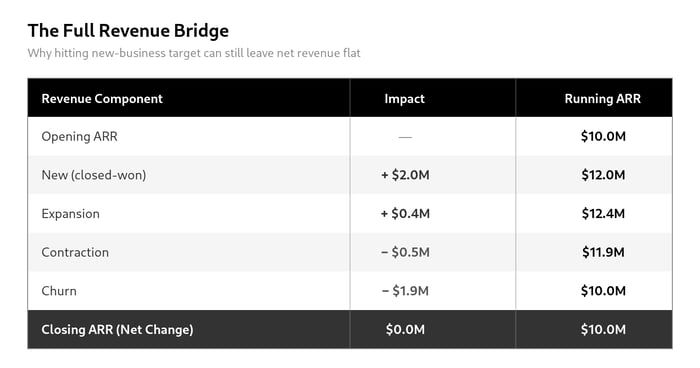
Here's the scenario that breaks executive trust fastest. A CRO forecasts $2M in new business, hits it exactly, and reports a win. But net revenue is flat, because $900K in contraction and churn went untracked. The board asks the obvious question: how did we hit target and stay flat? There's no good answer when your forecast only counts new logos.
A forecast Finance can trust tracks the full revenue bridge:
- Opening ARR: the recurring revenue you started the period with
- New: closed-won new business
- Expansion: upsell and cross-sell within the base
- Contraction: downgrades and reduced seats
- Churn: lost customers and canceled subscriptions
- Closing ARR: where you actually landed
Set up HubSpot's Forecast tool with separate new-business and renewal pipelines so each revenue motion has its own view. Build recurring revenue reports from your subscription custom objects that break out MRR and ARR movement by new, expansion, contraction, and churn. This is the difference between a sales forecast and a revenue forecast. It's the version Finance can actually take to the board.
The Executive Dashboard That Ends the Two-Version-of-Truth Problem
When Sales, CS, and Finance each define activation, churn, and renewal differently, you get three versions of the truth and zero trust in any of them. The cure is a single executive dashboard, built on governed data, that everyone references.
That dashboard should show the full revenue bridge from opening to closing ARR, current NRR and GRR trending over the trailing twelve months, renewal pipeline coverage by quarter, and a reconciliation view that ties closed-won and closing ARR to what the billing system actually invoiced. Because your subscription custom objects are the source, and because they sync downstream to your ERP or billing platform (NetSuite, QuickBooks, Stripe, or Chargebee), the CRM number and the billed number finally agree. When the CFO and the CRO look at the same dashboard and see the same figures, the two-version-of-truth problem disappears.
Frequently Asked Questions
Should renewals use the same deal pipeline as new business?
No. Renewals belong in a separate pipeline with their own stages and forecast categories. New business and renewals have very different sales motions, conversion rates, and close-date behavior. Mixing them corrupts your pipeline coverage math and your win-rate reporting. A separate renewal pipeline also lets you automate renewal-deal creation from your contract custom object and forecast retention on its own, which is what makes GRR and NRR measurable in real time.
Should post-sale stages live in the Lifecycle Stage property or a custom object?
Keep Lifecycle Stage lean and use custom objects plus a dedicated Customer Status property for the post-sale journey. Lifecycle Stage is one-directional and tied deeply to marketing and sales attribution reporting. Overloading it with states like At-Risk or Churned breaks funnel analytics and can't handle win-backs. Use a Subscription or Contract custom object for the financial backbone and a Customer Status property for the operational health signal.
How do I handle multi-year and ramp deals so ARR reporting stays accurate?
Never book a ramp deal as a single flat total. Record the Total Contract Value alongside the contract term and start date, then use calculated properties to derive ARR. For rising pricing ($100K, $150K, $200K over three years), model each year's value on the subscription custom object so both ARR reporting and the revenue recognition schedule reflect the real ramp. The deal captures the sales event. The subscription objects carry the year-by-year revenue reality.
What's the minimum data set Finance needs to trust the CRM forecast?
Five must-have fields, governed at the point of entry: a standardized amount type (pick TCV or ARR and enforce it), a governed close date tied to signature, a forecast category, a renewal date on the contract object, and a customer status. Enforce them with required-property rules on stage changes and data-quality workflows that flag anything missing.
Do I need Commerce Hub / native Subscriptions, or should I integrate a billing system?
If your billing is simple, like standard recurring plans and simple terms, HubSpot's native Subscriptions and Commerce Hub can carry recurring revenue and sync to payment processing directly. If you have complex revenue recognition, usage-based billing, or an existing ERP of record like NetSuite, integrate it and treat HubSpot as the upstream source of truth for what gets billed. Either way, the customer journey in the CRM must define the revenue. The billing system executes on it.
Conclusion
Finance doesn't distrust your CRM because HubSpot is a bad tool. They distrust it because the customer journey was built to move deals, not to produce revenue anyone can defend. The fix isn't a new platform. It's a disciplined customer journey revenue operations architecture where every stage change produces data that reconciles to billing and revenue recognition.
That means separating lasting revenue records from sales events using custom objects, standardizing what a deal amount means, governing close dates and forecast categories, automating renewal creation so retention lives in the system, and forecasting the full revenue bridge instead of new business alone. Each of these is a specific, buildable change in HubSpot, not a philosophy.
When you get it right, the payoff is trust. The CRM number and the billed number agree. NRR and GRR are ready on demand, not rebuilt in a spreadsheet. And when the CFO and CRO look at the same dashboard, they finally see the same truth. That's when your CRM stops being a sales tool Finance puts up with and becomes the revenue system of record the whole business runs on.
References
- KeyBanc Capital Markets, "Annual SaaS Survey: Net Revenue Retention Benchmarks," 2023.
- Bain & Company, "The Economics of Customer Retention in Subscription Businesses," 2022.
- Harvard Business Review, "The Value of Keeping the Right Customers," 2020.
- HubSpot, "Sales Pipeline Coverage and Forecast Accuracy Benchmarks," HubSpot Research, 2023.
- SaaS Capital, "Retention Benchmarks for Private B2B SaaS Companies," 2023.
.png?width=120&height=120&name=Gemini_Generated_Image_u8lxggu8lxggu8lx%20(1).png)