- Share
-

-

When contracts, billing, and CRM work as three separate systems, revenue leaks through the cracks. Not because your team is careless, but because you're asking them to match up three versions of the truth by hand. The gap between "deal closed" in the CRM and "money collected" in billing is exactly where renewals get missed, forecasts fall apart, and customers get billed for the wrong amount. And it gets worse as you grow. Let's break down where the damage happens and what a connected system actually looks like.
The Three-System Problem: Why CRM, Contracts, and Billing Drift Apart
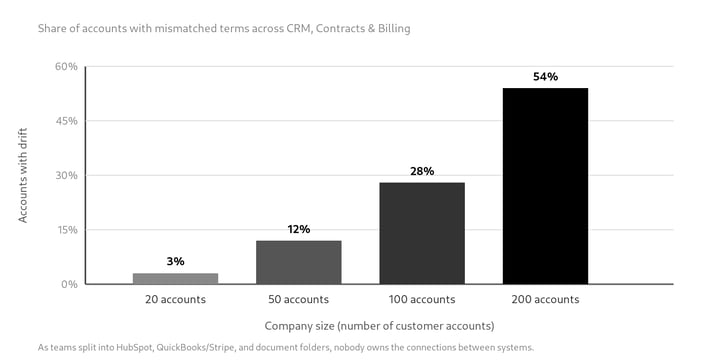
Early on, this drift is invisible. You have twenty customers. One salesperson also handles billing. Everyone knows every account by name. Contract terms live in someone's head, and that works fine, until it doesn't.
As you grow past 50, 100, 200 accounts, the systems split up. Sales lives in HubSpot Deals. Finance lives in QuickBooks, NetSuite, or Stripe. Legal or Ops stores contracts in a document folder. Each team makes its own tool better, and nobody owns the connections between them. The "we'll integrate it later" call feels smart when you're busy closing deals. But "later" always costs more, because by then you have thousands of records full of mismatches that someone has to untangle by hand.
Here's the truth at the system level: each of these tools holds one piece of the same revenue lifecycle. The Deal is the booking. The contract sets the terms and duration. Billing is the cash. When they don't share data, no single system can answer the most basic revenue question: "what did we sell, what are we billing, and what did we collect?" Not without a manual project, anyway.
The Reconciliation Tax: What Manual Data-Matching Actually Costs You
Every week, somewhere in your company, a RevOps analyst or a finance controller opens two spreadsheets side by side and starts matching records. CRM deal amount against invoiced amount. Signed contract term against what billing actually charged. This is the reconciliation tax, and it's one of the most expensive line items nobody puts on a budget.
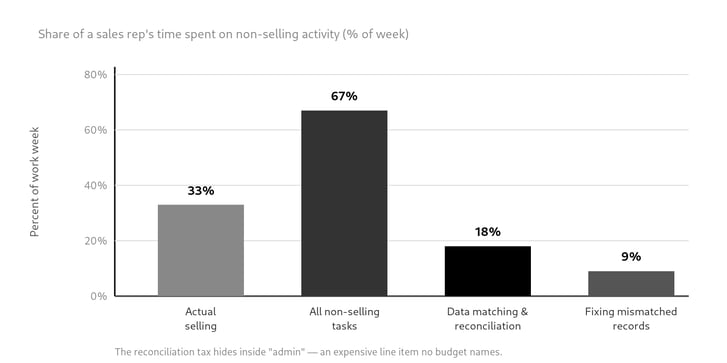
Think about the math. Sales reps already spend roughly two-thirds of their time on tasks that aren't selling, and admin reconciliation is a big slice of that. [1] Now add the finance hours. If a controller spends six hours a week matching bookings to billings, that's over 300 hours a year spent confirming that numbers which should already match, actually match. That's not analysis. That's data cleanup, and it grows right alongside your customer count.
The reconciliation tax has a second, sneakier cost: it speeds up data decay. CRM data goes stale at about 30% per year under normal conditions. [2] Disconnected systems make it worse, because no single source of truth keeps things accurate. When three systems each hold a slightly different contract value, all three are wrong in a way nobody can trust. And every report downstream inherits that error.
Where Renewals Die: The Contract Data Blind Spot
This is the most preventable revenue loss in all of B2B SaaS. Renewals die when contract terms live anywhere except structured, reportable fields in your CRM.
Think back to the phantom renewal from the opening. A contract end date buried in a PDF can't trigger a workflow. An auto-renewal clause in a Word document can't alert a CS manager 90 days out. A price increase in a spreadsheet can't show up on a renewal forecast. If the data isn't structured, the process can't be automated. And if it can't be automated, it depends on a human remembering. Humans forget. Then a $4,000 admin miss turns into a lost account and a longer CAC payback, because winning back a churned customer costs far more than keeping one. [3]
In HubSpot, the fix is about architecture. You build a Custom Object for contracts that stores start date, end date, renewal term, auto-renewal flag, and escalator percentage as separate properties. Then you build a deal-based workflow that automatically creates a renewal Deal, say 120 days before the contract ends, and assigns it to the account owner. The blind spot closes because the trigger now owns itself. Nobody has to remember. The system remembers.
Three Forecasts, Zero Truth: The Reporting Gap
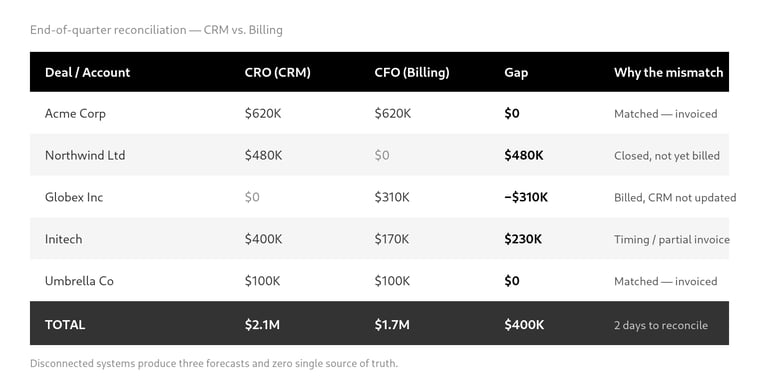
Picture the end-of-quarter meeting. The CRO reports $2.1M closed. The CFO's billing system shows $1.7M invoiced. That $400K gap is now the only thing anyone wants to talk about. And it takes two full days of manual work to explain. Some deals closed but aren't billed yet. Some were billed but never updated in the CRM. And some are just timing differences no one can piece back together quickly.
This is what disconnected systems produce: three forecasts and zero truth. Sales forecasts new bookings. Finance forecasts cash. CS forecasts renewals. Three systems, three numbers, none of them line up. Leadership can't trust any single figure, so they hedge every decision. Meanwhile the finance team burns its credibility explaining gaps that shouldn't exist.
Strong contracts billing CRM integration pulls those three forecasts into one connected model. In HubSpot, Line Items are the bridge. They carry what was sold, products, quantities, and discounts, from the Quote into the Deal and downstream into billing. When your bookings-versus-billings view runs on the same line-item data both teams rely on, the $400K gap never shows up at quarter-end. There was never a divergence to reconcile in the first place.
The Customer Feels It First: CX Damage from Disconnected Systems
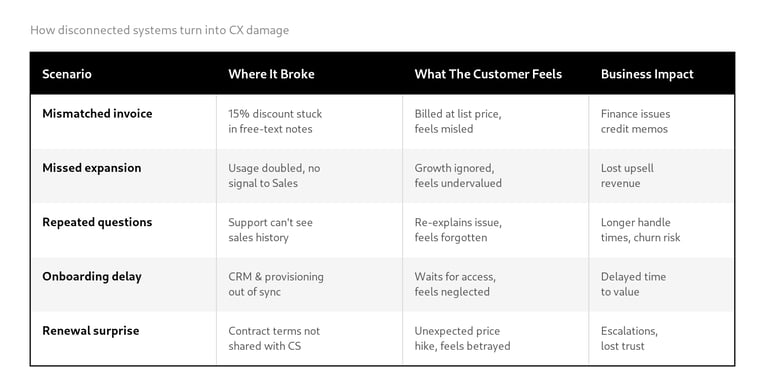
Your customer doesn't see your systems architecture, but they feel every crack in it. Take the mismatched invoice. A rep closes a deal at a negotiated 15% discount. The discount lives in the deal notes, a free-text field nobody downstream reads. Billing invoices at list price. Now the customer is annoyed, Finance is scrambling to issue credit memos, and the rep looks incompetent to the very customer they just won.
Or the expansion that never happened. A customer's usage doubles, which is a textbook upsell signal. But usage data lives in billing, health signals live in the CS tool, and the account owner lives in the CRM. None of them are connected, so nobody acts. The expansion window closes unnoticed, and you leave new revenue on the table from an existing, happy account.
Every one of these chips away at trust. And trust is the foundation of retention. Best-in-class B2B SaaS companies keep net revenue retention above 120%. Poorly integrated ones struggle to hold 100%. [4] The difference isn't always product quality. It's whether the operational machine matches the deal the customer actually signed.
What "Connected" Actually Looks Like in HubSpot
There are two clean paths to solving contracts billing CRM integration. You should pick one on purpose, rather than drift into a hybrid mess.
The HubSpot-native path. For many mid-market orgs, the CRM-to-billing gap disappears entirely with Commerce Hub. Quotes and Line Items built in HubSpot carry pricing, discounts, and terms as structured data, not in a rep's head. Subscriptions handle recurring billing, invoices, and payments inside the same system as the CRM. That means MRR, ARR, contraction, and expansion reporting are all native. Your renewal forecast, your bookings-versus-billings view, and your NRR and GRR dashboards all pull from one dataset. There's nothing to reconcile because there's only one source.
The integration path. If you're committed to NetSuite, QuickBooks, Stripe, or Chargebee, the goal isn't to get rid of the second system. It's to decide, for each type of data, which system owns which field. HubSpot Deals own bookings and pipeline. Your billing platform owns invoices and collected cash. A Custom Object owns contract terms. Then you design the sync on purpose: which fields move, in which direction, and how conflicts get resolved. The trap to avoid is a two-way sync on fields where ownership is fuzzy. That's how you end up with two systems overwriting each other with different "truths."
Either way, the rule is the same: one source of truth per data domain. Bookings have one owner. Cash has one owner. Contract terms have one owner. Cross the streams and you're right back to the reconciliation tax.
Frequently Asked Questions
Do I need HubSpot Commerce Hub, or can I integrate my existing billing system?
Both work. The decision comes down to complexity and what you're already committed to. If your billing is mostly straightforward recurring subscriptions and you're not deeply tied to an external ERP, Commerce Hub removes the CRM-to-billing gap entirely by keeping everything in one system. If you're running complex revenue recognition, multi-entity consolidation, or you're locked into NetSuite, integrate instead. But do it on purpose, naming a single source of truth for each field. The wrong answer is a half-built integration where both systems think they own the same data.
Where should contract data live, in the CRM, a document management tool, or the billing system?
The signed PDF can live in your document folder. But the contract terms must live as structured data in your CRM. Store start date, end date, renewal term, auto-renewal flag, and any escalator as separate properties on a HubSpot Custom Object. The document is the legal record. The structured fields are what drive automation, renewal forecasts, and reporting. If your renewal trigger can't read it, it doesn't count.
How do I forecast renewals in HubSpot if my contract dates aren't in the system yet?
Start with a backfill sprint. Build the contract Custom Object first. Then focus on entering end dates for every account renewing in the next two quarters. That's your immediate risk window. Once those dates are structured, a deal-based workflow can create renewal Deals automatically, and you can build a renewal forecast report based on contract end dates and renewal stages. You don't need every old contract entered on day one. You need the next 180 days of renewals visible right away.
What's the minimum viable integration between CRM and billing?
At a minimum, sync the invoiced amount and payment status from billing back onto the HubSpot Deal or Company record. That one connection lets you build a bookings-versus-billings view and spot gaps before they become a quarter-end fire drill. It won't give you full quote-to-cash, but it kills the worst of the reconciliation tax. And it gives leadership one place to see the link between bookings and cash.
How do disconnected systems actually affect NRR and GRR?
Directly, and you can measure it. Missed renewals from contract blind spots drop gross revenue retention for reasons that are totally preventable. Every renewal that lapses because no one saw the end date is pure, avoidable churn. Missed expansion signals hold down net revenue retention, because you never act on upsell chances sitting in your usage data. When Sales, CS, and Finance are tightly aligned, NRR tends to be much higher. [5] The integration is what makes that alignment real instead of just a goal.
Conclusion
Disconnected contracts, billing, and CRM don't announce themselves with one big failure. They bleed you slowly. A missed renewal here, a wrong invoice there, two days lost to reconciliation every quarter-end. Each incident looks like a one-off. Together, they're a structural tax on your revenue that grows every time you add a customer.
The fix isn't more effort from your team. Asking people to remember contract dates and match records harder isn't a strategy. It's the problem restated. The fix is architecture: structured contract data in the CRM, Line Items bridging what's sold to what's billed, workflows that own their own triggers, and a clear decision about which system is the source of truth for each type of data. Whether you go native with Commerce Hub or integrate an outside billing platform, the principle holds. Contracts billing CRM integration is what turns three arguing systems into one revenue engine you can actually trust.
Start with the accounts renewing in the next two quarters. Get those contract terms into structured fields, set up the renewal workflow, and build the one report that reconciles bookings to billings. That's not a twelve-month transformation. It's a focused sprint that stops the most expensive leaks first. The companies holding 120%+ net revenue retention aren't smarter than yours. Their systems just talk to each other.
References
- Salesforce, "State of Sales Report," 5th Edition, 2023, finding that sales reps spend roughly two-thirds of their time on non-selling and administrative tasks.
- Validity, "The State of CRM Data Management," 2023, on CRM data decay rates of approximately 30% per year.
- Harvard Business Review, "The Value of Keeping the Right Customers," 2014, on the higher cost of acquiring versus retaining customers.
- KeyBanc Capital Markets, "SaaS Survey," 2023, benchmarking net revenue retention across B2B SaaS companies.
- Boston Consulting Group, "Aligning Revenue Operations for Growth," 2022, on the correlation between cross-functional RevOps alignment and higher net revenue retention.
.png?width=120&height=120&name=Gemini_Generated_Image_u8lxggu8lxggu8lx%20(1).png)