- Share
-

-

Here's a quick test. Open the last twenty contracts your company signed. Now tell me how many have a notice-period-end date sitting in a real, reportable field in HubSpot. Not in a PDF. Not in a shared drive folder called "Signed Agreements 2024." I mean a field your workflows can actually use.
If the honest answer is "zero," you've just found where 5 to 10% of your recurring revenue quietly disappears every year [1]. Most B2B companies treat a signed contract as a legal document. It's a DocuSign confirmation to file and forget. But every contract is packed with useful operational data: renewal dates, notice periods, payment terms, price increases, and SLAs. Capturing that data as CRM fields and wiring it into automation is what I call contract data operations. It's the single most overlooked area in mid-market RevOps.
Research from World Commerce & Contracting keeps putting the value lost to poor contract management at about 9% of annual revenue [2]. That's not a rounding error. That's the difference between a company running 95% Gross Revenue Retention and one bleeding out at 85%. Let's fix it.
The Contract Is Not the End of the Deal - It's the Start of the Data
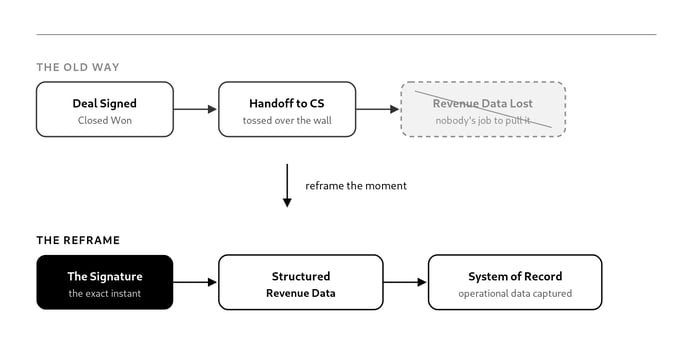
Sales culture teaches everyone to treat the signature as the finish line. The deal moves to Closed Won, the champagne comes out, and the account gets tossed over the wall to Customer Success. In that handoff, the most valuable operational data your company will ever have about that account gets lost. Why? Because it's nobody's job to pull it out.
Let's reframe the moment. The signature isn't the finish line. It's the exact instant that structured revenue data should enter your system of record. A signed contract tells you exactly when you'll be at risk of churn, exactly how much you're allowed to charge next year, and exactly what service promises you have to keep. That's not legal fine print. That's a forecast, a renewal plan, and a margin plan, all sitting in a PDF where no workflow can reach it.
The math makes this neglect expensive. Depending on the study, winning new revenue costs 5 to 25 times more than keeping the revenue you already have [3]. Yet most RevOps tools and process work focus on the top of the funnel. Contract data operations is how you protect the revenue you already fought to win.
The Five Data Points Every Contract Hands You (and What They Unlock)
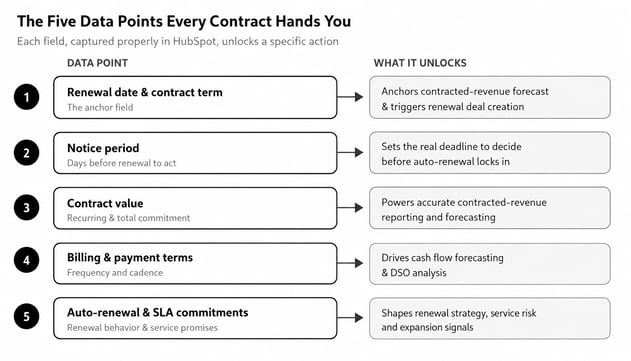
Every commercial contract, hands you five kinds of operational data.
1. Renewal date and contract term. The obvious one. On its own, though, it's nearly useless for driving action (more on that below). Captured as a Deal or Contract property, it becomes the anchor for your contracted-revenue forecast and the trigger for creating renewal deals.
2. Notice period. This is the number of days before renewal that the customer must give notice to cancel. 30, 60, and 90 days are common. This is the field that really controls when you have to act. It's also the field almost nobody tracks.
3. Payment terms and billing frequency. Net 30 versus Net 60, monthly versus annual billing. These drive cash flow forecasting and Days Sales Outstanding (DSO) analysis. They're also the fields where your CRM and billing system most often disagree.
4. Price escalation clause. The "3% annual uplift" or "5% year-over-year increase" language buried in section 4.2. Captured as a number, it becomes automatic margin on every renewal. Ignored, it's money you leave on the table forever.
5. Auto-renewal flag and SLA commitments. Whether the contract auto-renews (Y/N) changes your whole renewal approach. And SLAs, like 4-hour response times, uptime guarantees, and penalty clauses, shape both your service risk and your expansion signals.
Five data points. Each one maps straight to an automation or a forecast. The job of contract data operations is to make sure all five make it out of the PDF and into structured HubSpot properties the moment the contract is signed.
Notice Periods: The Single Highest-ROI Field in Contract Data Operations
If you do nothing else after reading this article, do this one thing. Create a notice-period-end date property and fill it in for every active contract.
Here's why it matters more than the renewal date. Think about the silent auto-renewal loss I've watched happen dozens of times. A customer signs a 12-month contract that renews January 1, with a 90-day notice period. That means the real deadline, the last day the customer can cancel, is October 2. Your CS team, working off the renewal date, schedules a "renewal check-in" for mid-November. By then the notice window has slammed shut. The customer already made their decision in September and told you nothing. Now you're either eating the churn or stuck fighting over an auto-renewal the customer claims they tried to exit.
The renewal date tells you when the money stops. The notice-period-end date tells you when you've already lost. Your renewal motion has to fire off the second one, with buffer.
The build in HubSpot is simple, and it's the highest-value automation you'll create all year:
- Create a date property called Notice Period End Date on your Deal or Contracts custom object.
- Build a date-based workflow that enrolls records and triggers actions at set times before that date. For example, create a renewal task 120 days out, generate a renewal deal at 90 days, and send an alert to the CS manager at 60 days.
- Send the task or deal to the account owner with the contract value and escalation terms already filled in on the record.
This one workflow turns your whole renewal book from a reactive scramble into a scheduled, forecastable motion. It's the backbone of Gross Revenue Retention. Best-in-class GRR runs 90% or higher, while the median sits around 80 to 85% [4]. The gap between those numbers is very often just unmanaged notice windows.
Turning Price Escalators Into Automatic Margin
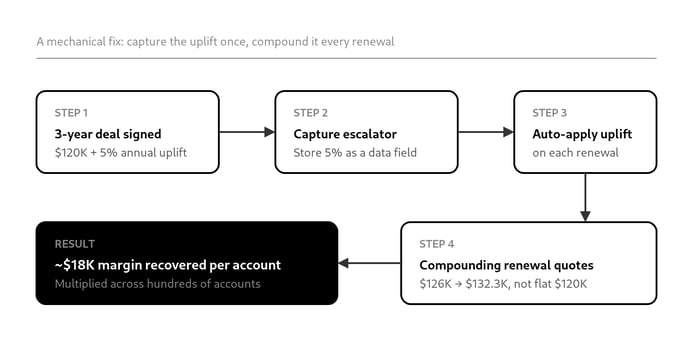
Let me show you the most avoidable loss in all of contract data operations. A company signs a three-year deal on a $120K account with a 5% annual uplift clause. Nobody captures the escalator as a property. So year two's renewal quote goes out at $120K. Year three, same thing. Three flat renewals on a contract that entitled the company to compounding increases. That's roughly $18,000 of margin quietly given away. Now multiply that across a book of a few hundred accounts.
The fix is mechanical once the data exists. Capture the escalator as a number, call it Price Escalation %, at signing. Then use a HubSpot calculated property to figure out the renewal ACV automatically: current ACV multiplied by (1 + escalation %). When your notice-period workflow creates the renewal deal, it fills in the escalated figure, not the flat one. The rep or CS manager sees the correct number by default and has to actively change it to under-quote. That's the opposite of today, where under-quoting is the path of least resistance.
You're not asking your team to remember contract terms. You're building those terms into the system so the right behavior happens on its own. That's the whole idea behind contract data operations: standardize the field, and the process enforces itself.
Building Your Contract Data Model in HubSpot: Custom Object vs. Deal Properties
Here's the design question I get most: should contract data live on the Deal record or in a dedicated Contracts custom object? The answer depends on complexity and volume, and getting it wrong creates painful migrations later.
Use Deal properties when you have simple, single-product deals with one contract per customer and clean one-to-one renewals. Add your renewal date, notice-period-end date, payment terms, billing frequency, escalation %, and auto-renewal flag right onto the Deal as properties. It's fast to build, easy to report on, and plenty for most companies under a certain complexity level.
Build a Contracts custom object when you have any of these: multi-product deals, several active contracts per company, overlapping terms, mid-term amendments, or contracts that don't map cleanly to a single deal. A custom object linked to both Company and Deal lets you model reality, like one company with three active contracts on different renewal cycles, instead of forcing that reality into a single Deal record it doesn't fit.
My default advice for mid-market B2B with recurring revenue: start with Deal properties if your motion is simple, but plan for the custom object the moment you add multi-year, multi-product, or amendment-heavy contracts. Add Company-level roll-up properties too, like total contracted ARR, renewal status, and health, so leadership gets a portfolio view without digging into individual records. And keep your renewal work in a separate Renewal Pipeline with its own stages (Renewal Identified, Renewal Quoted, Renewal Committed, Renewed/Churned) so renewal forecasting never gets tangled up with new business.
Forecasting the Revenue You Already Have
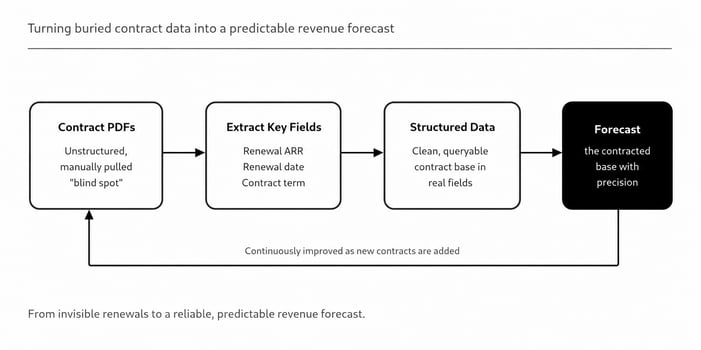
Ask most CROs "what's our contracted revenue for next quarter?" and watch RevOps vanish for two days to manually pull contract PDFs. That's the forecasting blind spot. Finance forecasts new bookings from the deal pipeline with real precision. But the biggest and most predictable revenue stream, the contracted base, is invisible, because renewal ARR, renewal date, and contract term never made it into structured fields.
Once contract data is structured, forecasting the base becomes easy. Use HubSpot's Custom Report Builder to break contracted revenue out by renewal month, segment, and owner. Build a GRR view that isolates renewal deals and tracks renewed versus churned ARR. Layer expansion and contraction on top to model Net Revenue Retention, the single strongest predictor of B2B SaaS valuation. Top-quartile companies run 120% or higher, while the median sits around 100 to 106% [5].
One honest note on HubSpot's native Forecast tool: it's built for new-business pipeline and struggles with recurring renewal revenue [6]. The reliable path is a dedicated Renewal Pipeline feeding the Custom Report Builder, where you control the stages and the ARR math. That combination gives Finance a renewal forecast they'll actually trust, because it's built on structured contract data, not guesswork.
Closing the CRM-to-Finance Gap
The last piece of contract data operations is the handshake between HubSpot and your billing system. When payment terms, billing frequency, and contract value in the CRM don't match what's in Stripe, NetSuite, or QuickBooks, Finance's cash flow forecast and DSO analysis are built on sand.
Capture payment terms and billing frequency right in HubSpot, through CPQ and Quotes at the point of sale, and on the contract record after that. Then set a clear source-of-truth rule for each field: HubSpot owns the commercial terms and renewal timeline, while the billing system owns invoiced amounts and payment status. Sync them through a maintained integration so a Net 60 term negotiated by sales actually shows up in the cash forecast, and so contracted value lines up with what's being billed. HubSpot's Commerce Hub Subscriptions can handle native recurring billing for simpler models [7]. Just know its current limits before you assume it replaces a dedicated billing platform for complex, usage-based deals.
Frequently Asked Questions
Should contract data live on the Deal record or in a custom object?
Use Deal properties for single-product, simple renewals with one contract per customer. It's fast and easy to report on. Move to a dedicated Contracts custom object once you have multi-product deals, several active contracts per company, overlapping terms, or frequent mid-term amendments. The trigger is complexity, not company size. Plan the custom object before you need it, because migrating live data later is painful.
How do I automate renewals if all my contract terms are different?
This is the most common objection, and it comes from a misunderstanding. You don't standardize the terms. You standardize the fields. Every contract has a notice period, whether it's 30, 60, or 90 days. Capture it as a notice-period-end date, and every contract, no matter how unique its wording, turns into the same date property. Your workflow fires off that date no matter how different the underlying terms are. Standardized fields, not standardized contracts, are what make automation possible.
What's the difference between renewal date and notice-period-end date, and why does it matter?
The renewal date is when the contract term ends and money either continues or stops. The notice-period-end date is the last day the customer can give notice to cancel, usually 30 to 90 days earlier. The notice window is what actually forces action. If you build your renewal motion off the renewal date, you're already too late by the time you engage. The customer's decision window has closed. Always trigger your renewal workflows off the notice-period-end date, with buffer.
Can HubSpot forecast renewal revenue, or do I need a separate tool?
You don't need a separate tool, but you shouldn't lean on the native Forecast tool for renewals. It's built for new-business pipeline. The reliable approach is a dedicated Renewal Pipeline with its own stages, feeding the Custom Report Builder where you control the ARR math. That combination produces a contracted-revenue and renewal forecast, plus GRR and NRR views, that Finance will actually trust.
How do I keep contract data in HubSpot in sync with my billing system?
Assign a source of truth by field. HubSpot should own the commercial and renewal terms: contract value, renewal date, notice period, escalation %, payment terms. The billing system should own invoiced amounts and payment status. Connect them through a maintained integration so terms negotiated in the CRM flow into billing and cash forecasting, and so contracted value lines up with what's actually invoiced. Never let the two systems drift. A quarterly reconciliation report catches gaps before they corrupt your forecast.
Conclusion
The gap between "contract signed" and "contract data put to work" is where mid-market companies quietly lose revenue they've already earned. It's not a sales problem or a legal problem. It's a data problem, and data problems are exactly what RevOps exists to solve. Every renewal that slips through an unmanaged notice window, every flat quote on an escalating contract, every two-day scramble to answer "what's our contracted revenue," is a symptom of the same root cause: operational data trapped in PDFs instead of living in structured fields.
The fix isn't a new tool. It's discipline applied to the tool you already own. Capture the five data points at signing. Build the notice-period workflow. Turn your escalators into calculated properties. Separate your Renewal Pipeline. Reconcile with Finance. None of this is technically hard in HubSpot. It's just work that no one has been made responsible for. Assign that responsibility and the leak closes.
Start with the audit. Pull your last twenty contracts and count the notice-period-end dates in your CRM. Whatever number you find is a direct measure of how much of your recurring revenue is currently exposed. Contract data operations turns that exposure into a forecastable, automatable, margin-protecting engine, and it starts with a single field.
References
- Gartner, "Reducing Revenue Leakage Through Contract Lifecycle Management," 2023.
- World Commerce & Contracting, "Contracting Value and Commercial Practices Report," 2023.
- Harvard Business Review, "The Value of Keeping the Right Customers," 2022.
- SaaS Capital, "Gross Revenue Retention Benchmarks for Private B2B SaaS Companies," 2023.
- KeyBanc Capital Markets, "Annual SaaS Metrics Survey: Net Revenue Retention Benchmarks," 2023.
- HubSpot, "Forecast Tool Overview and Limitations," HubSpot Knowledge Base, 2024.
- HubSpot, "Commerce Hub Subscriptions and Recurring Billing Documentation," HubSpot Knowledge Base, 2024.
.png?width=120&height=120&name=Gemini_Generated_Image_u8lxggu8lxggu8lx%20(1).png)