- Share
-

-

Walk into most B2B SaaS companies and you'll find a customer health score somewhere. It sits in a Service Hub dashboard. The CS team glances at it before a QBR. It's color-coded, it's tidy, and it does almost nothing. That's the problem. A health score that only feeds support conversations is a vanity metric. The moment you tie customer health score revenue outcomes together, like renewals, expansion, forecast accuracy, and executive triage, the score stops being a report. It starts being a revenue engine. That's the gap between describing risk and acting on it. It's also where most RevOps teams leave money on the table.
I've built health scoring models across more than 60 HubSpot implementations. The ones that work share one trait: the score triggers action across the revenue lifecycle. The ones that fail are owned by CS alone, cut off from Deal records and the numbers Finance actually reports to the board. Let's fix that.
Why Most Customer Health Scores Are Dead Weight
Here's the pattern I see. The CS team builds a health score, usually a mix of ticket volume, CSAT, and a subjective "sentiment" rating a CSM updates when they remember to. It shows up as a red, yellow, or green badge on a dashboard nobody outside CS opens. When an account turns red, the best case is a Slack alert. No workflow fires. No renewal Deal gets flagged. The forecast doesn't move. Finance never sees it.
The result is the "surprise churn." A CFO watches a $180K logo walk at renewal, and CS swears they "had no idea." But look at the record. The champion left 90 days earlier. Product usage dropped 40%. Two invoices went 30 days past due. Three hard signals, none connected, none triggering a play. A health score wired to revenue flags that account at day 90, not at day 360 when the renewal Deal is already lost.
The core failure is structural. The score lives on the wrong object, measures the wrong inputs, and connects to nothing downstream. It describes health when it should trigger action. Fixing it means rethinking three things: what feeds the score, what the score sets in motion, and where it lives in your HubSpot data model.
The Inputs That Actually Predict Revenue
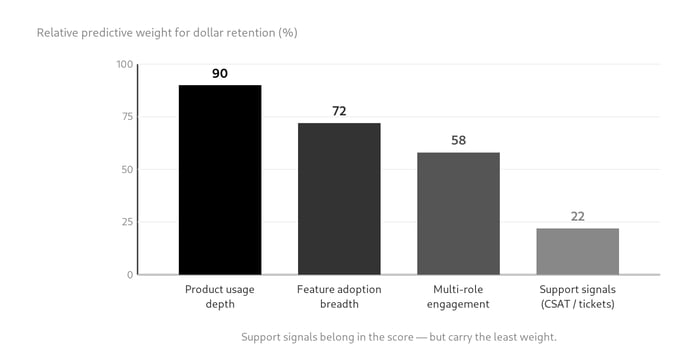
Ticket volume and CSAT feel like health. They're weak predictors of dollar retention. A quiet account with no tickets can be a ghost town about to churn. A noisy account filing tickets is often engaged and invested. Support signals belong in the score, but they should carry the least weight. The inputs that actually predict revenue retention fall into three groups:
Product usage depth. Not logins, depth. Seat use, how many features they've adopted, how often each role logs in. An account using 3 of 12 core features at 40% seat use is a churn risk, no matter how happy they sound on a call. This is the single strongest signal [1]. It's also the one most often missing from the score, because it lives in the product database, not the CRM.
Stakeholder engagement. When did you last meet with the economic buyer? Is your champion still employed? How many contacts at the account are opening your emails? A single-threaded account where the champion has gone dark is a red account, no matter what usage says. HubSpot already tracks last meeting date and email engagement, so use it.
Financial and payment behavior. This is the most predictive input almost nobody scores. Late payment is one of the strongest churn signals in B2B [2]. An account 30 days past due on invoices is telling you something about its intent to renew, long before the renewal conversation. If you run HubSpot Commerce or a billing integration, that payment status should feed straight into the health score.
Weight these on purpose. Usage depth and stakeholder engagement should dominate. Financial signals should carry real weight. Support metrics should round out the model. Build it in HubSpot as a set of calculated and score properties on the Company object. And be opinionated. Manual weighting you understand beats a black-box algorithm you can't explain to the board.
Wiring Customer Health Score Revenue Signals Into Your Renewal Forecast
This is where the score earns its keep. Most renewal forecasts are built on garbage. RevOps brings a $4.2M renewal number to the board at a flat 92% probability. The board asks the only question that matters, "which accounts are at risk?", and the room goes silent. A blanket percentage is a guess dressed up as a forecast.
A health-weighted forecast is defensible. You split the renewal book by health tier and apply different probabilities based on your own past retention data. Green accounts renew at 97%, yellow at 78%, red at 45%. Now that $4.2M breaks into a weighted number you can stand behind. More important, it becomes a ranked list of at-risk dollars the room can act on.
In HubSpot, the setup is simple but non-negotiable. First, build a dedicated Renewal Pipeline separate from your new-business pipeline. Renewals are their own motion with their own stages, and mixing them corrupts both forecasts. Second, connect the Company health score to the renewal Deal so the health data travels to the forecast. Third, build a custom Renewal Forecast Report that splits renewal Deal amount by health tier, using your health-weighted probabilities instead of a flat percentage.
The benchmarks give you a reality check. Best-in-class B2B SaaS runs Net Revenue Retention above 110%, while median mid-market lands around 100 to 105% [3]. Gross Revenue Retention best-in-class is 90% or higher [4]. If your health-weighted forecast points to a GRR well below 90%, you don't have a forecasting problem. You have a retention problem the score just surfaced. That's the point. The score should make hard truths visible while there's still time to act.
From Green Score to Expansion Revenue
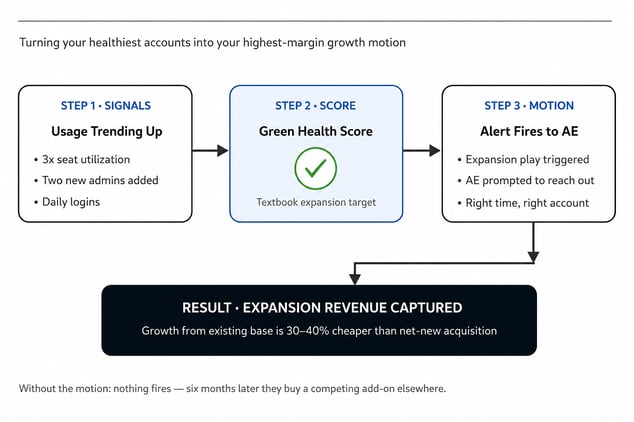
Health scoring isn't only about protecting the downside. Your healthiest accounts are your highest-margin growth opportunity, and most companies miss it. Take the account that hits 3x seat use, adds two new admins, and logs in daily. Textbook expansion target. In most orgs, nothing fires. Six months later they buy a competing add-on from another vendor, because your AE never knew to ask.
That's a failure of motion design. Expansion revenue from your existing base is usually 30 to 40% cheaper than net-new acquisition [5]. Winning a new customer costs 5 to 7 times more than expanding one you already have [6]. Green health plus a usage threshold is the strongest, lowest-cost buying signal you'll ever get. It should trigger a play, not sit on a dashboard.
Build the trigger in HubSpot with a Company-based Workflow. When health hits green and usage crosses your threshold, enroll the primary contact in an expansion Sequence, create a task for the account owner, and flag the account on an expansion dashboard the AE team actually works. Now "healthy and under-provisioned" becomes a repeatable revenue motion instead of a lucky accident.
Health-Triggered Executive Escalation
With 400 accounts and 6 CSMs, you can't give every account executive attention. You shouldn't try. Health tiering is a triage system for scarce senior attention. It tells you which 15 accounts need a VP-level touch this quarter: the red-health accounts above an ACV threshold, where a save is worth the CRO's calendar time.
Set up an executive escalation workflow in HubSpot. When health drops to red and ACV clears your threshold, notify the VP or CRO, log a task, and set a review date. This is how a $200K at-risk logo gets senior help while a $12K account gets a standard CSM playbook. The score sends human attention where it moves the number.
Building It in HubSpot: Objects, Workflows, and Reports
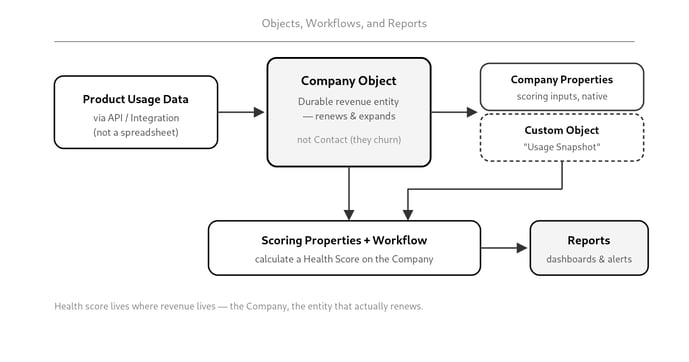
Let's get concrete. Here's the setup I deploy.
Object model. The health score lives on the Company object, the durable revenue entity, not the Contact. Contacts churn, change jobs, and multiply. The Company is what renews and expands. Bring in product usage data through an API or integration, either onto Company properties or into a dedicated Custom Object like a "Usage Snapshot," so your scoring inputs live natively in HubSpot instead of in a spreadsheet nobody trusts.
Scoring properties. Use HubSpot calculated properties and score properties to weight your inputs: usage depth, stakeholder engagement (last meeting date, email engagement), support signals (open tickets, CSAT), and financial signals (payment status, contraction history). Roll them into a single health tier property: red, yellow, green.
Workflows that create action. Three at minimum. A red-health workflow that creates a CSM task, notifies the account owner, and enrolls the renewal Deal in an at-risk playbook. A green-plus-usage workflow that fires the expansion motion. And the executive escalation workflow for high-ACV red accounts. Every tier change should do something.
Reporting and forecasting. Build a single source of truth. The same health property feeds CS, Sales, and Finance dashboards. Create a custom report that combines Deal stage and health property to show pipeline-at-risk in dollars. If you're on Sales Hub Enterprise, tie Playbooks to health tier so renewal and QBR conversations follow the score. And pull payment and invoice status from HubSpot Commerce or your billing integration into the model, because late payment is the churn predictor nobody scores.
The RevOps Operating Rhythm
A health score is only as honest as the routine that maintains it. Ownership matters. RevOps owns the model, meaning the inputs, weights, and property logic. CS owns the action on what the score surfaces. Blur that line and the score drifts into a subjective sentiment field that predicts nothing.
Weekly, CS reviews the accounts that changed tier and confirms the triggered plays are moving. Monthly, RevOps checks the health-weighted renewal forecast against actual renewals to calibrate the tier probabilities. Quarterly, Sales, CS, and Finance meet on the same dashboard to align expansion targets, at-risk saves, and the forecast the board sees. Automate the scoring inputs wherever you can. A health score updated by hand is a stale health score, and stale scores erode the trust that makes the whole system work.
Frequently Asked Questions
What data should feed a customer health score for revenue purposes?
Weight product usage depth (seat use, feature adoption, frequency by role) and stakeholder engagement (last meeting date, champion status, multi-threading) most heavily, since these are the strongest predictors of dollar retention [1]. Include financial signals like payment status and contraction history, because late payment is a top churn indicator that's almost never scored [2]. Support metrics like ticket volume and CSAT belong in the model, but they should carry the least weight, because they describe activity, not revenue risk.
Should the health score live on the Contact or the Company in HubSpot?
The Company object, without exception. The Company is the durable revenue entity. It's what renews, expands, and churns. Contacts change jobs and multiply across an account. Score at the Company level, then connect that Company health score to the renewal Deal so the data travels into your forecast. Contact-level engagement data still feeds the model as an input, but the score itself belongs on the Company.
How do I build a health-weighted renewal forecast in HubSpot?
Build a dedicated Renewal Pipeline separate from new business, connect each renewal Deal to its Company's health score, and create a custom report that splits renewal Deal amount by health tier. Apply different close probabilities per tier based on your past retention. For example, green at 97%, yellow at 78%, red at 45%, instead of a single blanket percentage. The output is a defensible weighted number and a ranked list of at-risk dollars.
How is a customer health score different from a lead score?
Direction and object. A lead score points at acquisition. It predicts whether a prospect will buy, and it lives on the Contact. A health score points at retention and expansion. It predicts whether an existing customer will renew or grow, and it lives on the Company. The inputs differ too. Lead scores weight fit and buying-intent signals, while health scores weight usage, engagement, and payment behavior after the sale.
Do I need Service Hub or Revenue Hub to do this?
You can build a working health score with the custom properties, calculated properties, and workflows available on Professional tiers. That covers scoring, tier-based automation, and reporting. Sales Hub Enterprise adds Playbooks tied to health tier. Service Hub helps if support signals are a meaningful input. For payment-based signals, you'll want HubSpot Commerce or a billing integration feeding invoice status. Start with what you have. Custom properties and workflows get you most of the value before you buy another tier.
Conclusion
A customer health score that only feeds support conversations is a report. A score wired into your renewal forecast, your expansion motion, and your executive escalation is a revenue system. The difference isn't a fancier algorithm. It's whether the score triggers action across the lifecycle or sits quietly in a dashboard.
The path is clear. Score the inputs that actually predict retention, put the score on the Company object, connect it to a dedicated Renewal Pipeline, and let workflows turn tier changes into tasks, sequences, and forecast adjustments. Do that, and the surprise churn stops surprising you. The forecast you bring to the board becomes defensible. Your healthiest accounts turn into your highest-margin growth channel.
If your health score today is a color-coded badge nobody outside CS looks at, you're not measuring customer health score revenue impact. You're decorating a dashboard. The good news is that the fix is a configuration project, not a platform migration. Map your inputs, build your Renewal Pipeline, wire your workflows, and put every team on the same number. That's when the score finally starts driving the revenue it was always meant to protect.
References
- Gainsight, "The Essential Guide to Customer Health Scores," 2023. Product usage depth is cited as the leading predictor of net retention in B2B SaaS.
- ProfitWell (Paddle), "Payment Failures and Involuntary Churn in Subscription Businesses," 2022. Late and failed payments rank among the top predictors of customer churn.
- KeyBanc Capital Markets, "SaaS Survey: Private Company Metrics," 2023. Best-in-class Net Revenue Retention exceeds 110%, with mid-market medians near 100 to 105%.
- Bessemer Venture Partners, "State of the Cloud: Efficiency and Retention Benchmarks," 2023. Best-in-class Gross Revenue Retention sits at 90% or higher.
- Forrester Research, "The Economics of Customer Expansion in B2B SaaS," 2022. Expansion revenue from existing accounts costs roughly 30 to 40% less than net-new acquisition.
- HubSpot Research, "Customer Acquisition vs. Retention Cost Benchmarks," 2023. Acquiring a new customer costs an estimated 5 to 7 times more than retaining or expanding an existing one.
.png?width=120&height=120&name=Gemini_Generated_Image_u8lxggu8lxggu8lx%20(1).png)