- Share
-

-

That's backwards. Expansion revenue is cheaper to win, more predictable, and the single biggest lever on net revenue retention, the metric your board actually watches. Selling to a customer you already have converts at 60 to 70%, while a cold prospect converts at 5 to 20% [2]. Yet most B2B companies put a fraction of the process effort into it. This post makes the case that expansion revenue operations deserves more discipline than new business, and shows you how to build that discipline in HubSpot.
Expansion Revenue Operations Is a Motion, Not a Relationship
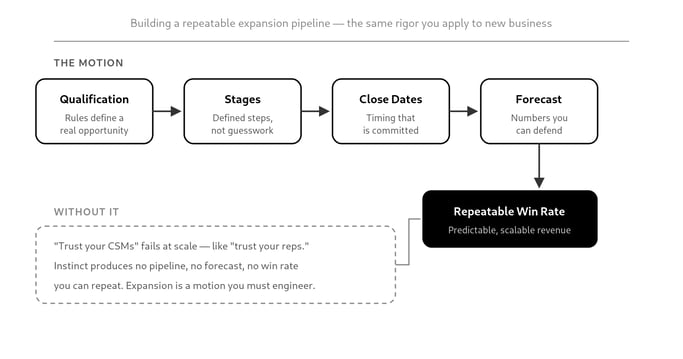
The most expensive assumption in B2B is that expansion takes care of itself if you hire good Customer Success Managers. It doesn't. "Trust your CSMs" fails at scale for the same reason "trust your reps" fails in new business. Instinct doesn't produce a pipeline, a forecast, or a win rate you can repeat.
Think about what you'd never allow in new business. You'd never run new-logo sales with no qualification rules, no stages, no close dates, and no forecast. You'd never let a rep say "I think Q3 will be fine" and call that a number. But that's exactly how most companies run expansion. It lives as a soft skill in someone's head instead of a system in your CRM.
A motion has structure. It has a trigger, meaning something happens that signals opportunity. It has a qualification step to ask if this is real. It has a clear path to close and a result you can measure. Relationships are the fuel, but the motion is the engine. When expansion is "account management's job" instead of a real system, you leave 20 to 30% of expansion revenue on the table [3]. That's not because your CSMs are bad. It's because no human can track usage thresholds, contract timing, health trends, and org-chart changes across 40 accounts from memory.
The fix is to treat expansion with the same care as new business: a dedicated pipeline, real signals, automated triggers, and a forecast Finance can count on.
The Four Signals That Actually Predict Expansion
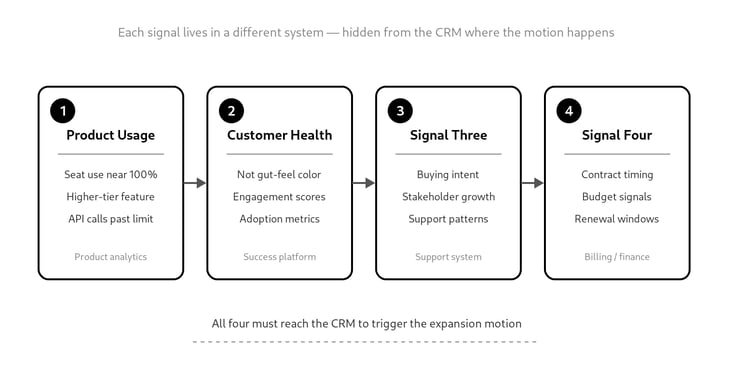
Expansion isn't random. Four signals predict it. The problem is that each one usually lives in a different system, hidden from the CRM where the motion actually happens.
1. Product usage. This is the clearest expansion signal there is. Think seat use nearing 100%, use of a feature that maps to a higher tier, or API calls climbing past a plan limit. This data sits in a product analytics tool or your app's database, not in HubSpot where the CSM works.
2. Customer health. Not a gut-feel color, but a mix of usage, support load, sentiment, and adoption. A truly healthy account is an expansion candidate. An unhealthy one is a shrink risk you need to catch before renewal.
3. Contract timing. Expansion has a window. Usage is high, budget is there, and the renewal is close. That's the moment. Miss it and the contract auto-renews at the old number, or the budget cycle closes.
4. Buying-committee changes. The champion who signed the first deal gets promoted or leaves. A new buyer shows up. These contact-level changes make or break both renewal and expansion, and almost nobody watches the org chart in a steady way.
Account management instinct catches maybe one of these, once in a while, by luck. A system catches all four, every time, and hands them to a person before the customer asks. That's the difference between reactive order-taking and a real expansion motion. When a customer emails to add 50 seats and Sales rushes a quote in three days, that revenue was coming anyway. Your process added nothing. The lift comes from getting there first.
Why Your Health Score Is Lying to You
Let me describe an account I've seen a hundred times. The CSM marks it "green" after a friendly QBR. Everyone felt good in the room. Meanwhile the product data tells a different story: three power users and 40 dormant licenses. That's not a green account. It's a shrink risk dressed up as an expansion target. At renewal the customer is going to right-size those seats and cut your ARR by a third.
Gut-feel health scores are worse than no score because they build false confidence. If you're going to score health, tie it to revenue outcomes and build it on data.
In HubSpot, build your Customer Health Score as a calculated property. Blend the inputs that really predict revenue behavior: license use rate, product usage trend over 30, 60, and 90 days, support ticket volume and severity, NPS or CSAT, and how close the renewal is. Weight them on purpose. I usually weight usage and license use the heaviest because they're the hardest to fake and the best predictors. Sentiment matters, but a happy customer who isn't using the product will still churn.
The output should sort accounts into clear expansion, hold, and at-risk groups. Every one of those groups should trigger a different play. A green account with 95% seat use and a renewal in 90 days isn't a "check-in later" account. It's an expansion deal waiting to be created.
Contract Visibility: The Expansion Blind Spot
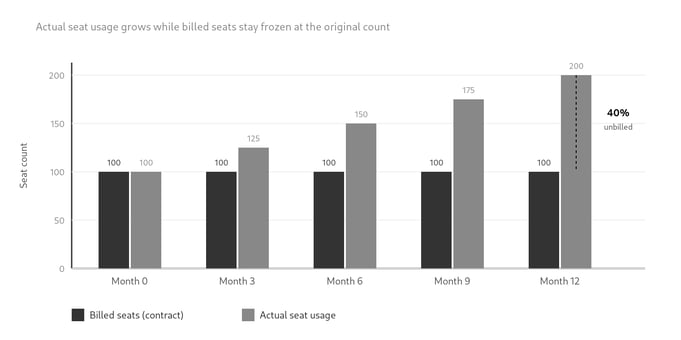
Here's the scenario that keeps CFOs up at night. A customer's seat usage doubled over 12 months. Nobody flagged it. The contract auto-renewed at the original seat count. Inside the company, everyone celebrated a "successful renewal." And the company left 40% of expansion revenue unbilled for another full year. The next chance to grab it is 12 months away, if the customer hasn't found a cheaper rival by then.
This happens because contract terms live in PDFs and billing systems, not in the CRM. If your renewal date, contract value, seat count, and auto-renew flag aren't structured data that automation can act on, you have no expansion visibility. You're flying blind on the most time-sensitive signal there is.
Get this data into HubSpot as structured fields. Use HubSpot Subscriptions and Commerce Hub to hold recurring revenue and renewal dates as real objects instead of buried contract text. Where native fields fall short, like tracking seat counts per line item or usage summaries, use Custom Objects tied to the Company. Make renewal date, current contract value, and auto-renew status required properties. No exceptions. A renewal deal with no close date and no contract value is as useless as a new-business deal without one, and you'd never allow that.
Once that data is structured, you can automate against it. That's where the real leverage lives.
Build a Dedicated Expansion Pipeline in HubSpot
The core structural fix in expansion revenue operations is this: stop cramming expansion into your new business or renewal pipeline. Build a dedicated Expansion Pipeline in HubSpot Deal Pipelines with its own stages and exit rules.
Why separate it? Because expansion has a different sales cycle, different qualification logic, and different forecast math than new business or renewal. When you mix them, you bury the expansion economics and can't report on any motion cleanly. You also blend keeping the customer (GRR) with growing the customer (expansion). Those are two very different jobs, and they hide each other's problems when combined.
A workable expansion pipeline looks like this:
- Usage Signal Identified — a trigger fired, like a usage threshold, feature adoption, or a jump in health score
- Qualified — a CSM or AE confirmed budget, need, and timing
- Proposed — quote delivered
- Negotiation — terms in discussion
- Closed Expansion — signed and ready to bill
Each stage needs exit rules, just like new business. And this part matters: apply HubSpot's Forecast tool to this pipeline with the same care. Expansion deals get weighted odds, close dates, and forecast categories. Suddenly "we think renewals will be fine" becomes "$1.4M in expansion pipeline, 3.2x coverage against a $440K target, 62% historical win rate."
For early-stage teams with low expansion volume, a property-based setup on your existing pipeline can work as a starting point. You can add a "motion type" property that flags new, expansion, or renewal. But the moment expansion becomes a real number, give it its own pipeline. The clearer reporting alone pays for the setup.
Automating the Expansion Trigger
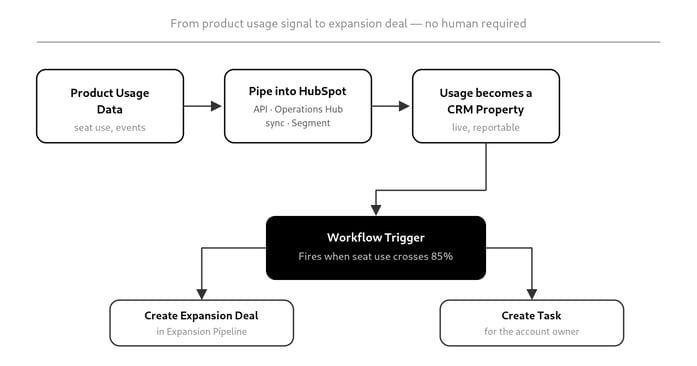
Signals are worthless if a human has to spot them by hand. This is what HubSpot Workflows are for.
Pipe product usage data into HubSpot through the API, Operations Hub data sync, or a native integration like Segment. Once usage is a real CRM property, build a workflow that fires when a threshold is hit, say seat use crosses 85%. It automatically creates an expansion deal in the Expansion Pipeline and a task for the account owner. The signal becomes a deal before the customer emails you.
Add renewal-window automation too. Set up a workflow that starts a renewal-and-expansion play 90 or 120 days before the contract ends, so the timing window never closes quietly. And build contact-based triggers. When a key contact's role changes or they're marked as having left, alert the CSM right away. The champion-departure problem, where a renewal quietly slips because nobody noticed the buyer left, is fully solvable with a contact property-change trigger.
Forecasting Expansion Like You Forecast New Business
Finance can forecast new pipeline down to the single deal. Ask them to forecast expansion and you get a shrug. That gap is unacceptable when expansion is often the bigger and more predictable number.
Use HubSpot's Custom Report Builder to build NRR and GRR dashboards, expansion pipeline coverage, and expansion win rates by segment. Split your deal-based revenue reports by motion, so new versus expansion versus renewal, to show the true revenue mix. Most leadership teams are shocked the first time they see how much of their growth comes from the base versus new logos.
The economics justify the effort. The best SaaS companies run 120% or higher NRR, while the median sits around 100 to 106% [4]. The gap between 100% and 120% is the difference between needing constant new-logo speed just to stand still and getting compounding growth from customers you already won. A 5% jump in retention can drive 25 to 95% more profit [5], and expansion is retention's upside twin. When you forecast expansion with real coverage math, you turn that upside from a hope into a number you can plan around.
Frequently Asked Questions
What's the difference between renewal revenue and expansion revenue, and why does it matter operationally?
Renewal revenue is keeping the customer at their current contract value. It protects gross revenue retention (GRR). Expansion revenue is growing the customer beyond their first spend. It drives net revenue retention (NRR) above 100%. In practice they need separate pipelines and separate forecasts because they answer different questions: "Will we lose this?" versus "Can we grow this?" When you blend them, shrinkage hides inside a "successful renewal" and expansion never gets the process investment it deserves.
Should expansion be owned by Sales or Customer Success?
Wrong question. Ownership by title creates turf wars. Ownership by a defined motion creates revenue. The answer is a shared motion with clear handoffs documented in HubSpot. The CSM owns signal spotting and qualification because they have the relationship and the usage context. Either the CSM or an account-executive layer owns the commercial close, depending on deal size and complexity. What matters is that every stage has one accountable owner and the handoff is a defined step, not a hallway chat.
How do I get product usage data into HubSpot to trigger expansion plays?
Three main paths: HubSpot's API for a custom integration, Operations Hub data sync for two-way syncing with connected systems, or a native integration like Segment feeding usage events in. Don't try to pipe in everything. Focus on the few metrics that predict revenue behavior: seat or license use, adoption of tier-gated features, and usage trend direction. Land that data on Company or Custom Object properties, then build workflow triggers against thresholds. Usage becomes a real CRM signal instead of a report nobody reads.
Conclusion
The companies winning at expansion aren't the ones with the friendliest CSMs. They're the ones who decided expansion deserved the same operational care as new business, then built the system to prove it. They made usage a CRM signal, tied health scores to revenue, pulled contract terms out of PDFs, and gave expansion its own pipeline and forecast.
None of this needs a new platform. If you're already on HubSpot, you have the objects, the calculated properties, the workflows, the Forecast tool, and the Custom Report Builder to run every one of the four signals. What's usually missing isn't technology. It's the decision to stop treating expansion as a relationship and start treating it as a motion.
Make that decision, and the math compounds in your favor: cheaper revenue, higher NRR, and a forecast Finance can actually trust. That's what mature expansion revenue operations delivers. And it's the fastest path to growth that most B2B companies are still leaving on the table.
References
- Bessemer Venture Partners, "State of the Cloud Report: The Rise of Net Dollar Retention," 2023.
- Marketing Metrics, Paul W. Farris et al., "The Definitive Guide to Measuring Marketing Performance," Wharton School Publishing, 2010.
- Gainsight, "The Financial Impact of Customer Success and Expansion Motions," 2022.
- KeyBanc Capital Markets, "SaaS Survey: Net Revenue Retention Benchmarks," 2023.
- Bain & Company, Frederick Reichheld, "Prescription for Cutting Costs: Loyalty-Based Management," 2001.
.png?width=120&height=120&name=Gemini_Generated_Image_u8lxggu8lxggu8lx%20(1).png)