
- Share
-

-

A white label HubSpot partner is a specialist team that delivers HubSpot implementation, workflows, onboarding, reporting, and content under your agency's brand. You keep the client, the pricing, and the relationship. The partner runs delivery in the background. Your margins stay protected. Your service line expands without new hires.
|
TL;DR
|
Why Agencies Are Rethinking In-House HubSpot Capacity in 2026
Most growing agencies hit the same wall around their fifth or sixth HubSpot retainer. The work compounds fast.
A Sales Hub migration here. A Service Hub onboarding there. A Marketing Hub workflow rebuild for a client who suddenly needs attribution.
Internal teams stretch. Senior consultants get pulled into delivery instead of strategy.
Margins drift downward, quietly. Then someone runs the numbers and realises the most profitable line in the agency has become the most expensive to staff.
The instinct is to hire. The reality in 2026 is harder.
Finding a HubSpot Certified Architect who also understands your niche, whether fintech, manufacturing, SaaS, or financial services, is no small task.
HubSpot's ecosystem now spans Operations Hub, Content Hub, Service Hub, and an AI layer that demands real implementation discipline.
"Knowing HubSpot" is no longer enough. You need specialists. And specialists are expensive to recruit, slow to onboard, and difficult to retain at agency salaries.
This is the gap a white label HubSpot partner is built to fill. You get on-demand access to certified delivery talent, packaged under your brand, billed at wholesale, and scaled up or down with your pipeline.
No payroll. No bench. No recruitment cycle.
The trade-off is real: you give up some control over delivery process. For most agencies between $1M and $10M ARR, that trade-off pays for itself inside the first quarter.
What Does a White Label HubSpot Partner Actually Do?
A white label HubSpot partner is a silent delivery arm. The specialist team performs the technical work behind your brand. That includes implementation, configuration, custom development, and reporting.
Your agency owns the client relationship. You set strategy, control communication, run pricing, and present the work.
The partner stays invisible to the client but powers the delivery.
The model is different from subcontracting or staff augmentation. A subcontractor talks to your client. A staff-aug resource sits inside your team and bills hourly.
A white-label HubSpot partner operates as an extension of your agency. Same delivery standards, same branding, same SLAs. But with their own QA, project management, and certifications running underneath.
What the client sees vs. what's actually happening
|
What your client sees |
What's actually happening |
|---|---|
|
Your logo on every deliverable |
Partner's certified team builds it |
|
Your project manager in every call |
Partner runs delivery in your PM tool |
|
Your invoice with your margins |
Partner bills wholesale to your agency |
|
Your senior consultant signing off |
Partner's QA layer caught issues first |
|
Your agency owning the relationship |
Partner protects that relationship by staying invisible |
When Should an Agency Start Using a White Label HubSpot Partner?
The decision to white-label is rarely a cost calculation alone. It's an agility decision.
The question is not "can we afford to outsource?" The real question is "can we afford to keep saying no to complex HubSpot work because our team is at 80% capacity?"
In our work with mid-size agencies, four signals consistently show up before the white-label conversation becomes urgent:
- Your senior team is doing junior work. Architects are configuring lifecycle stages because nobody else can.
- You are turning down or delaying technical RFPs that don't fit your current bench.
- Delivery margins on HubSpot retainers have dropped below 50%. Rework, scope creep, and context-switching are the usual causes.
- Clients are asking for capabilities like workflows, reporting, and custom integrations that sit outside your team's certifications.
If two or more of these are true today, you are already paying the cost of not white-labelling.
It just doesn't show up as a line item. It shows up as foregone revenue, slower delivery, and senior team burnout.
Which HubSpot Services Should You Be White-Labelling?
Not every HubSpot service is worth white-labelling. The ones that are share three traits.
They require certifications you don't keep on full-time staff. They carry technical risk if done badly. And they unlock retainer revenue once delivered.
Six service lines fit that test in 2026.
White-Label HubSpot Implementation
This is the foundation. Full Hub implementations across Sales, Service, Marketing, and Operations require certified architects, clean data migration, and integration discipline.
White-label HubSpot implementation gives you the ability to land enterprise deals. That includes migrations off Salesforce, Dynamics, and Pipedrive. You skip hiring a three-person CRM team.
The partner handles object architecture, property mapping, association labels, and lifecycle configuration. You own the discovery, scoping, and client communication.
White-Label HubSpot Workflows
Workflows are where most internal teams over-promise and under-deliver.
Lead routing, deal stage automation, lifecycle progression, sequence triggers, and Operations Hub data-sync logic all require deep platform fluency.
White-label HubSpot workflows let you offer sophisticated automation as a retainer line. Your team doesn't have to learn the platform's edge cases in real time.
This is one of the highest-margin services to resell. Pricing is project-based but delivery is heavily templated by experienced partners.
White-Label HubSpot Onboarding
HubSpot's own onboarding is generic by design. Agencies that wrap their own white-label HubSpot onboarding around it turn a one-time sale into a 90-day engagement.
That wrap includes industry-specific configuration, user training, and adoption playbooks. The partner runs the technical setup. You run the strategy conversations and training delivery.
For agencies that resell HubSpot licences, this also unlocks the partner-tier commission structure HubSpot pays on net-new revenue.
White-Label HubSpot Reporting Services
Reporting is where most agencies lose clients. Dashboards built once, never refreshed, full of vanity metrics.
White-label HubSpot reporting services solve this. You get a delivery team that builds custom report objects, attribution dashboards, revenue reporting in Operations Hub, and executive scorecards that map content engagement to pipeline.
This becomes a retainer add-on of $2K to $5K monthly. It protects the relationship and creates a natural upsell path into RevOps consulting.
White-Label Staff for HubSpot Agencies
Some agencies need ongoing capacity rather than project-based delivery. White-label staff for HubSpot agencies is the model that fits.
The partner provides dedicated FTE-equivalent resources. Architects, developers, marketers. They work inside your tools, attend your standups, and operate under your SOPs.
You get the capacity of a hire without the recruitment cycle, the W-2, or the bench risk during slow quarters.
White-Label SEO Content for HubSpot
Content remains the most under-delivered service in the HubSpot ecosystem. Most agencies promise pillar pages, topic clusters, and AEO-ready blogs.
Most stop at one pillar before the calendar collapses.
White-label SEO content for HubSpot fixes this. Keyword strategy, brief writing, and production live inside a single delivery line. The assets get published directly inside the client's Content Hub.
The economics are clean. Writers cost wholesale. Output is predictable. The work compounds in search.
How Do You Choose the Right White Label HubSpot Partner?
The wrong partner costs more than not having one at all. A missed deadline becomes your missed deadline. A broken workflow becomes your broken workflow.
The client never sees the partner. Every failure surfaces under your brand.
Five filters separate partners worth piloting from partners worth ignoring.
Step 1. Run the Pass/Fail Filters
Before strategy fit, before chemistry, before anything else, the partner must clear three non-negotiable gates.
- Proven HubSpot expertise. Not just certifications. Demonstrable delivery on projects at your complexity level. Ask for redacted scope documents.
- Process compatibility. Ability to work inside your tools, your SOPs, and your reporting cadence. Not impose theirs.
- Data and security discipline. NDAs signed without negotiation. Credentials handled through password managers, not Slack. Compliance posture documented.
If a candidate fails any of these three, end the conversation. There is no version of this that gets better later.
Step 2. Score Strategic Fit
Once the basics are in, evaluate whether the partner thinks like a partner or behaves like a vendor.
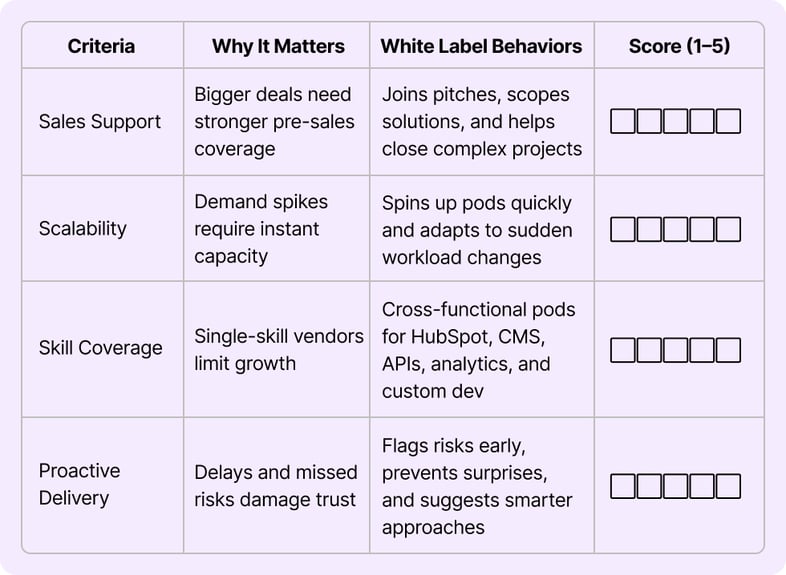
A real partner will push back on scope, flag risks early, and propose alternative approaches when yours is wrong. A vendor takes the brief and bills the hours.
Score on four dimensions: technical depth, communication discipline, proactive problem-flagging, and willingness to share IP. That last one includes templates, playbooks, and internal docs.
Step 3. Run a 14-Day Paid Pilot
Don't commit on day one. A 14-day paid pilot on a real but contained project surfaces almost every issue you'd otherwise discover during a live client engagement.
Test communication speed, QA discipline, on-time delivery, and flexibility when scope shifts mid-stream.
One Elite-tier partner we worked with ran a pilot building a complex NPS automation across Service Hub and Operations Hub. The partner delivered on time with zero escalations.
The agency expanded the engagement to a full migration plus CMS build within 30 days.
Step 4. Onboard the Partner Properly
Even strong partners fail when onboarded badly. Set them up to win.
- Tool and workflow access on day zero. No "we'll get you in next week."
- SOPs, brief templates, and reporting formats shared up front.
- Single dedicated communication channel. Slack, ClickUp, or Asana. Not three competing threads.
- Clear SLAs for response time, QA passes, and escalation paths.
Step 5. Scale With Discipline, Not Volume
Once the pilot converts and onboarding stabilises, scale by capability.
Not by pipeline pressure.
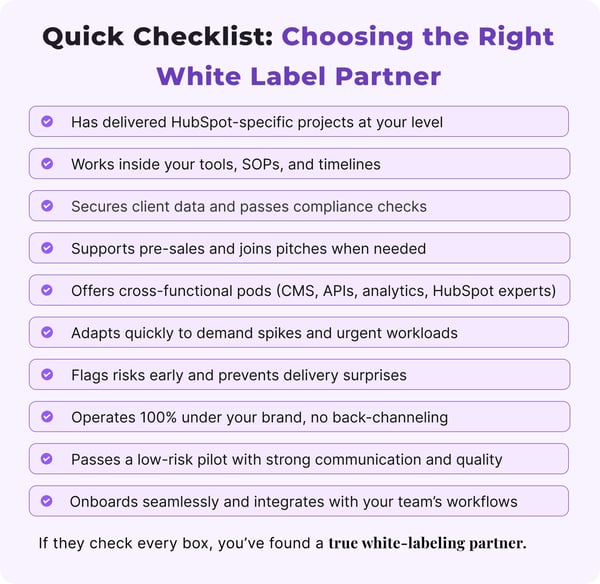
Map upcoming complex work weeks in advance. Build a capacity roadmap aligned to your sales pipeline, not your delivery anxiety.
Test new technical capabilities with the partner before pitching them to clients. That includes Operations Hub custom code, Breeze AI configuration, and programmatic SEO via HubDB.
Selling capabilities you haven't tested is the fastest way to lose both the deal and the partner.
What Does a White Label HubSpot Partner Actually Cost?
The cost question is the wrong question. The right question is what it costs not to.The numbers still matter. They are sharper than most agency owners realise when they first run them honestly.
Building a three-person in-house HubSpot delivery team (one architect, one developer, one marketer) runs roughly as follows in 2026:
|
Cost line |
In-house team (3 specialists) |
White label partner |
|---|---|---|
|
Annual salaries |
$280,000 |
$96,000 (wholesale fees) |
|
Benefits, taxes, overhead |
$56,000 |
$0 |
|
Tools, certifications, training |
$12,000 |
$0 |
|
Recruitment cost (year one) |
$25,000 |
$0 |
|
Total year-one cost |
$373,000 |
$96,000 |
|
Scalability |
Slow. New hires required. |
Instant. Usage-based. |
|
Bench risk during slow quarters |
High. Full salaries continue. |
None. Capacity flexes. |
The delta of roughly $277,000 in year one is not pure savings. Some of it gets reinvested in sales talent, brand marketing, or proprietary IP.
But it is capital that no longer sits trapped in payroll. For an agency between $2M and $5M in revenue, that delta is often the difference between hiring a senior salesperson, building a productised service, or sitting on cash.
Internal fulfilment costs on high-end HubSpot technical work typically run 60 to 70 percent of project fees. Well-run white-label models drop that to 30 to 40 percent.
The margin difference compounds quickly across a retainer book.
How Does the Workflow Actually Run With a White Label Partner?
A white-label HubSpot partnership is only as clean as the handoff between your team and theirs.
Five operational disciplines separate partnerships that scale from partnerships that quietly decay over time.
Track the same KPIs from day one
The strongest partnerships measure success together. Not separately.
Align on five metrics before the first project kicks off: on-time delivery rate, QA pass percentage, upsells spotted and closed, client NPS and retention, and revenue influenced by partner-delivered work.
One Diamond-tier partner we work with aligned on these five from day zero. On-time delivery moved from 74% to 96% within three months. That unlocked an additional $180K in revenue without a single new hire.
Run from one dashboard
Both teams must see the same priorities, the same timelines, the same blockers.
Centralise project tracking in one tool. ClickUp, Asana, or Jira. Pipe delivery status into Slack or Teams automatically.
One Elite-tier partner running twelve parallel HubSpot implementations adopted a shared ClickUp dashboard across their agency and ours. Handover errors dropped 42%. Delivery speed improved 27%. The delivery team didn't grow.
Communicate as one team, not as buyer and seller
White-label partners aren't vendors. They are an extension of your team.
Run weekly syncs to unblock scope early. Use dedicated Slack channels for fast updates. Define escalation paths in writing before they're needed.
The partners that succeed at this also volunteer information. Flagging risks, surfacing client patterns, suggesting upsell triggers. Without waiting to be asked.
Protect the agency and client relationship at all costs
The partner stays invisible to your client. No back-channelling. All communication flows through your agency.
Delivery standards must match or exceed what your in-house team would produce. A single voice and narrative with the client, every time.
The moment a partner messages a client directly, even with good intentions, the trust architecture collapses.
Scale intentionally with a 90-day plan
Don't throw random projects at a partner and hope. Plan growth in 90-day blocks aligned to your sales pipeline.
Map upcoming complex work weeks ahead. Build a capacity roadmap that anticipates two-quarter pipeline. Test new technical capabilities with the partner before they appear in client proposals.
What Are the Warning Signs of a Bad White Label HubSpot Partner?
Most partnerships fail in the first 60 days. Not because of skill gaps. Because of behaviour patterns that surface early and get ignored. Six warning signs are worth ending the engagement over, no matter how good the pricing looks.
- They take more than 48 hours to acknowledge a brief during the pilot. Response speed during sales is the best-case version of response speed during delivery.
- Their certifications are listed on the site but not held by the people doing the work. Always ask who specifically is assigned.
- They refuse to work inside your project management tool and push back hard on your SOPs. They want you to adapt to them, not the reverse.
- They market themselves to your clients directly through LinkedIn or email after onboarding. This has happened. End it the moment it does.
- They miss the first deadline with a long explanation. Good partners flag risk early. Bad partners explain late.
- They quote suspiciously cheap. Wholesale HubSpot work has real cost.
If it's 60% below market, somebody is cutting corners. Usually on QA, certifications, or the talent assigned.
|
KEY TAKEAWAYS
|
Partner With OneMetric as Your White Label HubSpot Team
OneMetric is a HubSpot Elite-tier partner. We offer white-label implementation, workflows, onboarding, reporting, CMS development, and SEO content for agencies.We work under your brand, inside your tools, against your SLAs.
Your client never sees us. Your margins stay protected. Your delivery capacity flexes with your pipeline. Hitting the capacity wall this article opened with? Book a 30-minute capability call.