- Share
-

-

A practitioner’s guide to the three use cases that deliver ROI, what they cost, and how to avoid the two mistakes that stall most builds.
It breaks predictably in two: when the data layer can’t carry the use case, and when governance gets retrofitted instead of designed. Skip the four-layer explainer. Read the scenarios.
I spent the better part of my professional journey as a CRM developer before finding my north star in the marketing side of the table.
Which means I have, at various points, been the person who built the pipeline that broke, the person who explained why it broke, and now the person who writes about why it keeps breaking for everyone else.
I bring this up because most Agentforce articles you’ll read are written from one of those three vantage points. You can usually tell which.
This one is written from all three. So when I tell you Salesforce’s Agentforce wins in three specific patterns and breaks in two specific places, I’m not borrowing the framework from a Gartner slide.
I’m telling you what the data, the customer stories, and frankly my own buyer conversations all point to once you strip away the conference-keynote tone.
What this blog does instead is tell you the three things Agentforce is genuinely good at, give you the named cases and the hard numbers behind each and a lot more.
What is Salesforce Agentforce? (An Overview for RevOps Leaders)
Agentforce is Salesforce’s autonomous AI agent platform.
The technical anatomy (Atlas Reasoning Engine for orchestration, Data Cloud for grounding, MuleSoft Agent Fabric for cross-system actions, Einstein Trust Layer for governance) is documented exhaustively elsewhere.
Three things you actually need to know:
How is Agentforce different from a chatbot?
First, this is not a chatbot. Chatbots respond. Agents take actions. The difference is not conversational polish, it is action authority.
| Dimension | Chatbot | Agentforce agent |
|---|---|---|
| Core function | Responds to questions | Completes tasks end to end |
| Data access | Scripted replies or an FAQ tree | Reasons over live CRM and Data Cloud |
| Action authority | None, it hands off to a human | Executes: refunds, updates, routing |
| Where it stops | At the answer | At the resolved outcome |
| Underlying tech | Rules and intent matching | Atlas Reasoning Engine plus Trust Layer |
| Best fit | Deflection and triage | End-to-end resolution |
| Fails when | The question goes off-script | The data is dirty or governance is absent |
Salesforce’s own customer service team, running Agentforce as "Customer Zero," handled 1.5 million+ support requests in year one, "the majority of cases without humans," per their own internal write-up.
Second, the quality of the agent is the quality of your data. SharkNinja, after 250,000 customer conversations through their personal shopper agent, summed up their biggest lesson in one line: "the agent is only as good as the data behind it."
This is the unsexy truth nobody puts on a Dreamforce slide.
Third, governance gets designed in, not bolted on. Salesforce’s own team famously launched their agent with a "competitor block list" that included Microsoft. Then a customer asked about integrating Microsoft Teams with Salesforce, and the agent politely refused to help.
They had to rip out the rigid rule and replace it with "act in the customer’s best interest." If Salesforce, with the entire product team in the building, learned this the hard way, you can assume you will too unless you design for it.
That’s the shape. Now let’s talk about where it actually earns its license cost.
Top 3 Agentforce Use Cases with Proven ROI
Across 18,000+ deployments and Salesforce's published case studies, three use cases recur with verifiable ROI. Named customers, hard numbers. I'll take them one at a time.
1. Agentforce for customer service: the highest-ROI use case
Agentforce's strongest published use case, by a wide margin. And the one with the most defensible ROI.
The pattern is consistent: high-volume, repetitive service requests with predictable resolution paths. Grounded in a structured knowledge base. With the agent empowered to complete the action reset a password, triage a payment, resolve a lockout not just describe it.
Customer examples: Wiley, Fisher & Paykel, Grupo Falabella
Why Agentforce works for customer service
Here's the thing nobody says out loud: the bar is low. Most enterprise chatbots are bad. They route. They FAQ. They apologize. Agentforce, grounded properly, completes the task. The delta isn't marginal. It's categorical.
When to use Agentforce for customer service (and when not to)
Use it when you have Service Cloud, a maintained knowledge base, and a resolution flow eating human time. Skip it when your knowledge base is a graveyard of outdated PDFs. The agent will reflect that. Confidently.
2. Agentforce for sales: inbound qualification at scale
The second use case with hard, published ROI. Salesforce's own Customer Zero data is the most compelling - they've been brutally transparent about both the wins and the early failures.
Customer examples: Salesforce, Jacuzzi, CentralSquare
Why Agentforce works for inbound (not outbound)
Inbound has a structural advantage. The prospect has self-selected. The context is available - form fill, signal, CRM history. The action paths are narrow: qualify, route, schedule, disqualify. Contained decision space. Clear handoffs.
Where Agentforce sales agents quietly break
Outbound prospecting at scale. Salesforce admitted their early SDR agent felt "too transactional," and they had to retune it. Cold outreach via agent is still a year early, in my view. Inbound, today, is the workable pattern.
3. Agentforce for internal IT: the underrated first build
Least Dreamforce stage time. Some of the cleanest ROI.
Password resets, access provisioning, ticket triage - all running natively inside Slack or Teams.
Customer examples: Accenture, Salesforce internal
Why Agentforce works for internal IT
The user already lives in Slack. The requests repeat. The action paths are bounded - reset, provision, escalate. The alternative is a legacy ITSM platform everyone hates renewing.
I've seen three serious ServiceNow displacement conversations triggered by Agentforce IT Service in twelve months. Deployment: weeks. Renewal sticker: seven figures. The math, frankly, is not subtle.
Why this is the best first Agentforce build
This is the scenario I'd recommend most companies start with. Low stakes. High confidence. Small data foundation (IT knowledge base, access management). Internal audience (forgiving). Measurable win (tickets deflected, hours saved). The most underrated entry point in the product line.
Which Agentforce use case is right for your business?
Three use cases, one decision: is your business ready to build one?
Run your candidate through the three questions below. If you can't reach the green node, you don't have an Agentforce use case yet. You have an Agentforce aspiration. Different things and conflating them is how 90 days disappear.
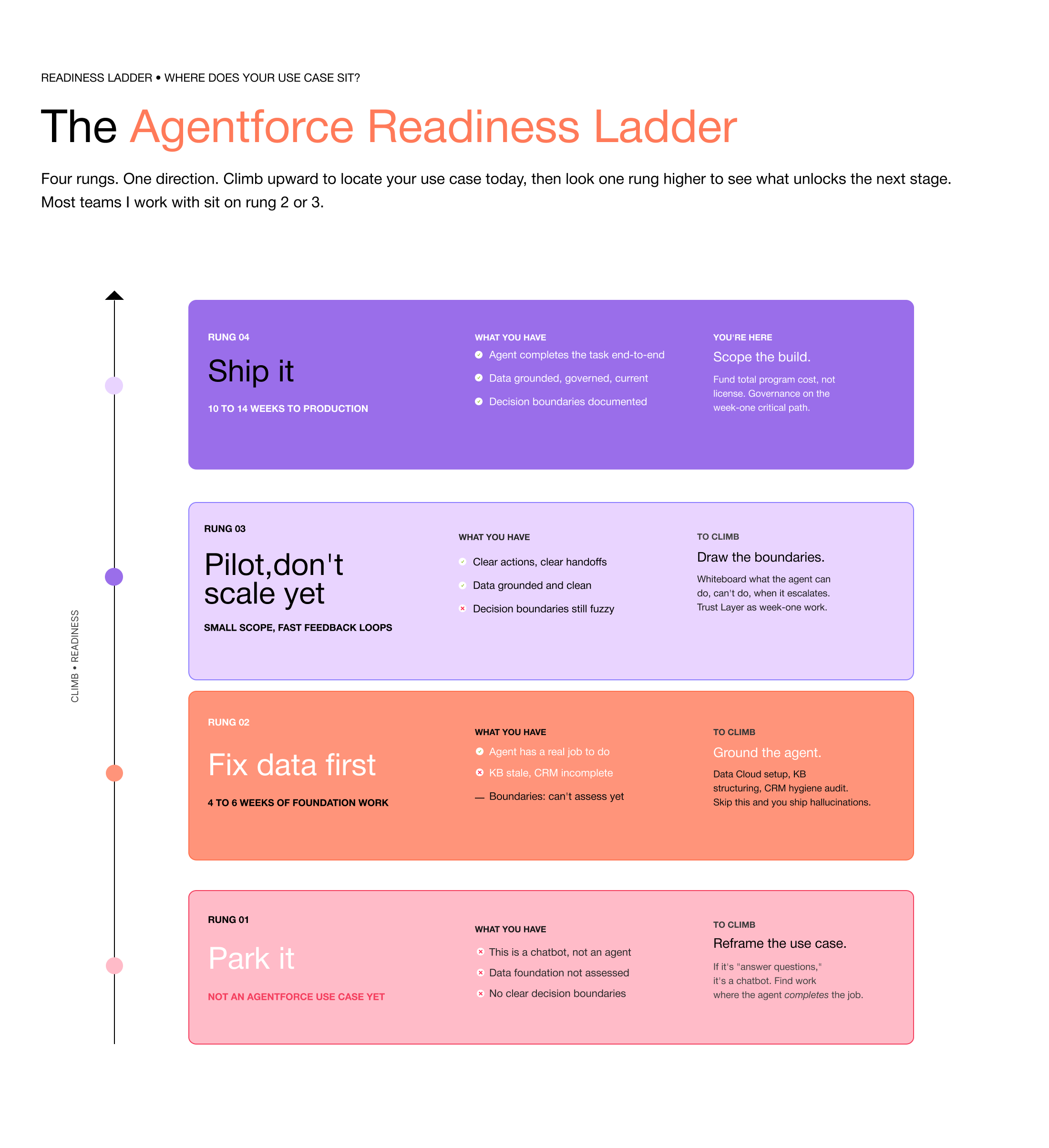 Most teams I work with land at "Fix data first." Some at "Pilot carefully." Few at "Ship it."
Why Agentforce Projects Fail: The 2 Main Implementation Risks
Now the honest part.
The platform is good. The customer stories are real. The ROI numbers stand up to scrutiny. None of that means a build won’t fall over in implementation.
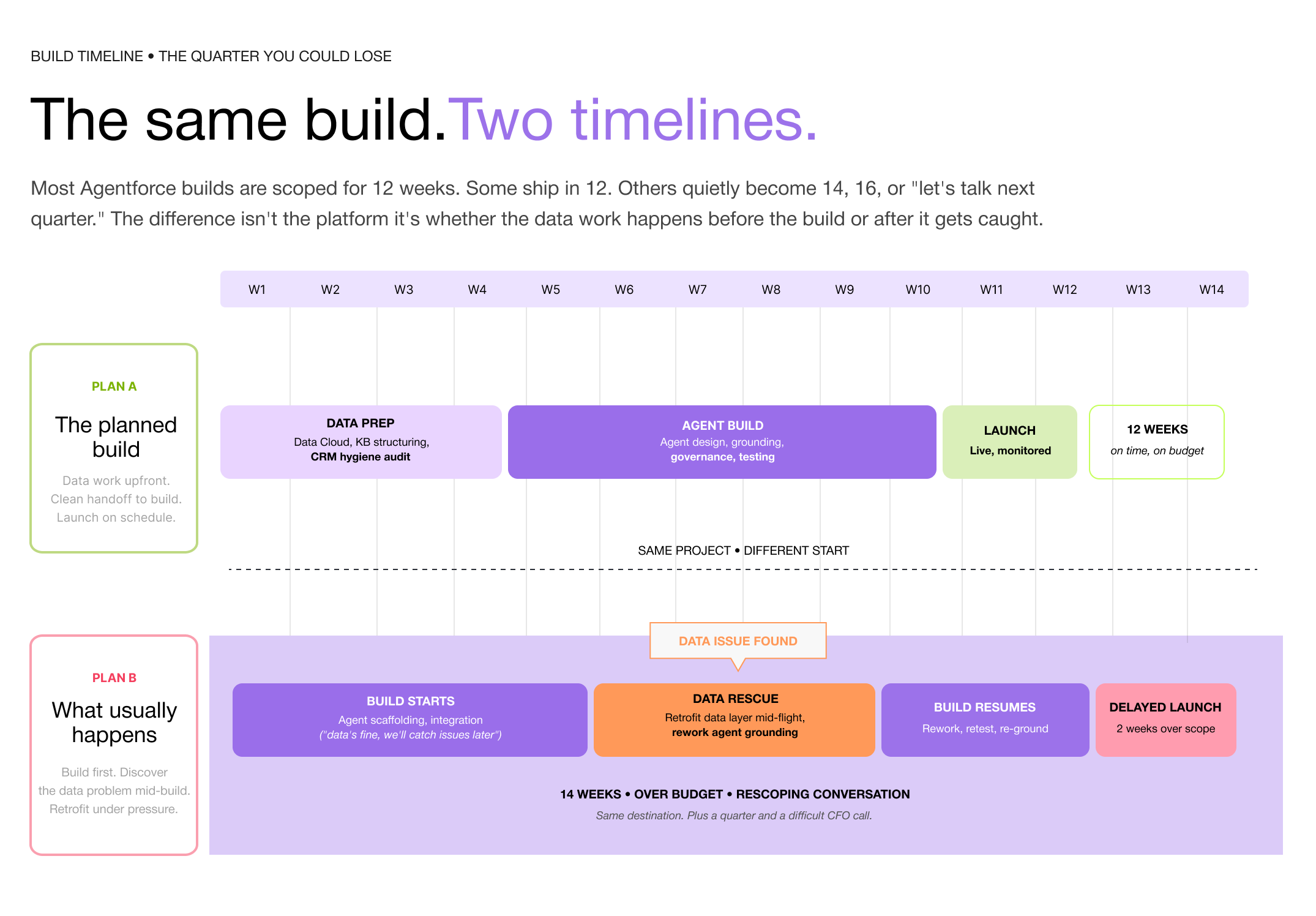
Most of the breakage I see clusters into two patterns. Not five. Two.
Get your data foundation right first
Every single customer in the published case studies that worked, worked because the underlying data was clean enough to ground the agent.
Wiley had a real knowledge base. Fisher & Paykel had thousands of structured product articles. Salesforce’s own deployment leans heavily on Data Cloud unification before any agent goes live.
When teams skip this, the failure is predictable and embarrassing.
SharkNinja, after 250,000 conversations in production, distilled the entire lesson into one sentence: the agent is only as good as the data behind it.
Nexo, an early adopter, faced what they publicly called "technical debt, data cleanup, and real-time troubleshooting with no playbook" before they reached 62% case resolution. Safari365 went live in six weeks, but only after confronting "hallucinations, missing guardrails, and technical gaps."
What this looks like in practice: your knowledge base is three years out of date, your CRM records have a 40% completeness gap, and your product taxonomy exists in three slightly different versions across teams.
The agent ingests all of it and produces fluent, confident, wrong answers. Hallucinations here are not a model problem. They are a hygiene problem.
The honest fix is not glamorous. Data Cloud setup, knowledge base structuring, grounding configuration, and a real audit of CRM completeness will eat four to six weeks of your timeline.
If you’re not allocating that time upfront, you will allocate it under pressure later. That math doesn’t change.
Design governance in from week one
This is the break that surprises smart teams, because the platform comes with a Trust Layer out of the box and it’s easy to assume that’s enough.
It is not. The Trust Layer is a fabric, not a configuration. It needs decisions: what data can the agent see, what actions can it take, what must it never say, who reviews its decisions, how is its activity logged for audit and compliance.
The Salesforce Customer Zero team learned this in public, which is generous of them.
They launched with a "competitor block list" that included Microsoft. A customer asked a perfectly reasonable question about integrating Microsoft Teams with Salesforce. The agent refused.
They had to rebuild the guardrail approach from rigid block lists to "act in Salesforce’s, and by extension, the customer’s, best interest." The shift was elegant. The lesson was expensive in pride.
In regulated industries (fintech, healthcare, financial services), retrofitted governance is worse than embarrassing.
It is the thing that blocks your pilot six weeks before go-live, when legal review finally arrives and discovers the agent has been quietly accessing data it has no business touching. I have seen this twice in the last eighteen months. Both times, the rescue was technically possible but politically expensive.
The pattern that works: governance becomes a real workstream in week one.
Not "we’ll figure out the Trust Layer config before launch." A named owner, a written policy, an access-review cadence, and an audit log architecture, all designed alongside the agent.
This is unglamorous, it adds two weeks to your week-one phase, and skipping it is the single most predictable way to lose a quarter.
Two breaks. That’s the honest count. If you see either of these starting to crack open in your build, the cost of intervention drops dramatically the earlier you catch it.
Agentforce Pricing and Total Cost of Ownership (TCO)
Salesforce sells Agentforce through several SKU paths: Agentforce One, conversation-based pricing, bundled Enterprise License Agreements.
List prices shift, and quoting them in a blog ages the article in roughly a quarter. Talk to Salesforce directly for current licensing.
The more useful framing, and the one I’d argue is underdiscussed in most procurement conversations, is total spend allocation. On a typical mid-market build:
-
Licenses: roughly 30% of first-year cost
-
Data foundation work (Data Cloud setup, knowledge structuring, grounding, integration): roughly 40%
-
Implementation services, change management, post-launch tuning: roughly 30%
The implication that catches people out: if leadership has approved a license number and assumes that’s the project budget, the project is underfunded before it starts.
The right framing is total program cost. The right time to surface that is during scoping, not during build.
When it surfaces during build, someone usually loses their job. Try not to let it be yours.
Where OneMetric fits on an Agentforce build
OneMetric is a CRM consultancy, a Salesforce partner and a HubSpot Elite partner (roughly the top 2% globally). Our view: Agentforce doesn’t succeed in isolation.
It succeeds based on how clean the CRM data, governance, and workflows underneath it are. That’s where we’re most useful, and most of it sits upstream of the agent itself - the same upstream work that decides whether HubSpot's own agent layer grounds cleanly too, for teams running both stacks
- Agentforce readiness and use case scoping, so teams pick a first build that can actually ship
- CRM data foundation work (Data Cloud, knowledge base structuring, hygiene audits), the part that decides whether an agent grounds cleanly or hallucinates
- Salesforce implementation and integration for hybrid HubSpot and Salesforce stacks
- Governance and Trust Layer planning, designed in early rather than retrofitted under legal review
On the build itself, we work alongside your team rather than positioning ourselves as a high-volume development shop. The category is young, the deep-certification SIs are still finding their footing, and the part that most often decides success is the CRM and data work underneath, which is exactly where our foundation is strongest - the same data and governance work behind the Salesforce rebuilds in our own client history.
How to scope your first Agentforce build
If your use case maps onto one of the three patterns here (service deflection, inbound qualification, internal IT) and your data is in better shape than "PDFs in a SharePoint folder no one has opened in 18 months," you have a real build.
Scope it for 10 to 14 weeks, fund it for total program cost rather than license cost, and put governance on the week-one critical path.
If it doesn’t map onto one of those, you have something more ambitious and riskier: a custom or multi-agent build. Buildable, but not your first project. Save it for build two.
If you’re scoping a build, or already underway and want a second opinion on use case fit, data readiness, or governance, our team runs free 30-minute scoping calls. No deck, no follow-up sequence.
I’ll tell you whether the failure modes in this article apply to your build, and where I’d intervene first.