


-
HIPAA & BAA
-
Patient intake
-
Referral CRM
-
Care journeys
HubSpot for healthcare.
HIPAA-compliant HubSpot CRM for healthcare — BAA configuration, patient intake automation, referral management and EHR integration, with the PHI boundary set before a single workflow goes live.
Trusted by healthcare teams at

Is HubSpot HIPAA-compliant?
A HIPAA-compliant CRM is a customer relationship platform covered by a signed Business Associate Agreement, configured with sensitive-data properties, restricted field access and audit logging. HubSpot supports all three, but the platform alone is not compliant — the contract and the configuration are what make it so.
HubSpot HIPAA compliance
Is HubSpot HIPAA-compliant?
Compliance is not a platform feature you switch on. It comes from a signed BAA, sensitive-property configuration and restricted access — and the first question is whether your CRM touches PHI at all. We answer it in week one, before anyone builds a workflow.
Signed BAA. Sensitive
properties. Audit trail.

Patient data enters the CRM, so the platform contract and the field-level configuration have to be right before go-live — not retrofitted after an audit finding.
- Telehealth & virtual care
- Provider groups
- Digital therapeutics & RPM
What this requires: executed BAA, sensitive-data properties enabled, restricted field access, logging and retention rules, and a documented data-flow map for your compliance team.
Standard CRM. Full analytics surface.
The buyer is an institution, not a patient. No BAA constraint, which means the whole reporting and automation surface stays available to you.
- Medtech & devices
- Health SaaS
- Pharma & life sciences
What this unlocks: full custom reporting, call recording and conversation intelligence, attribution across the buying committee, and standard enrichment — none of which is available once PHI is in scope.
We design around the BAA carve-out. Most teams find it at audit.
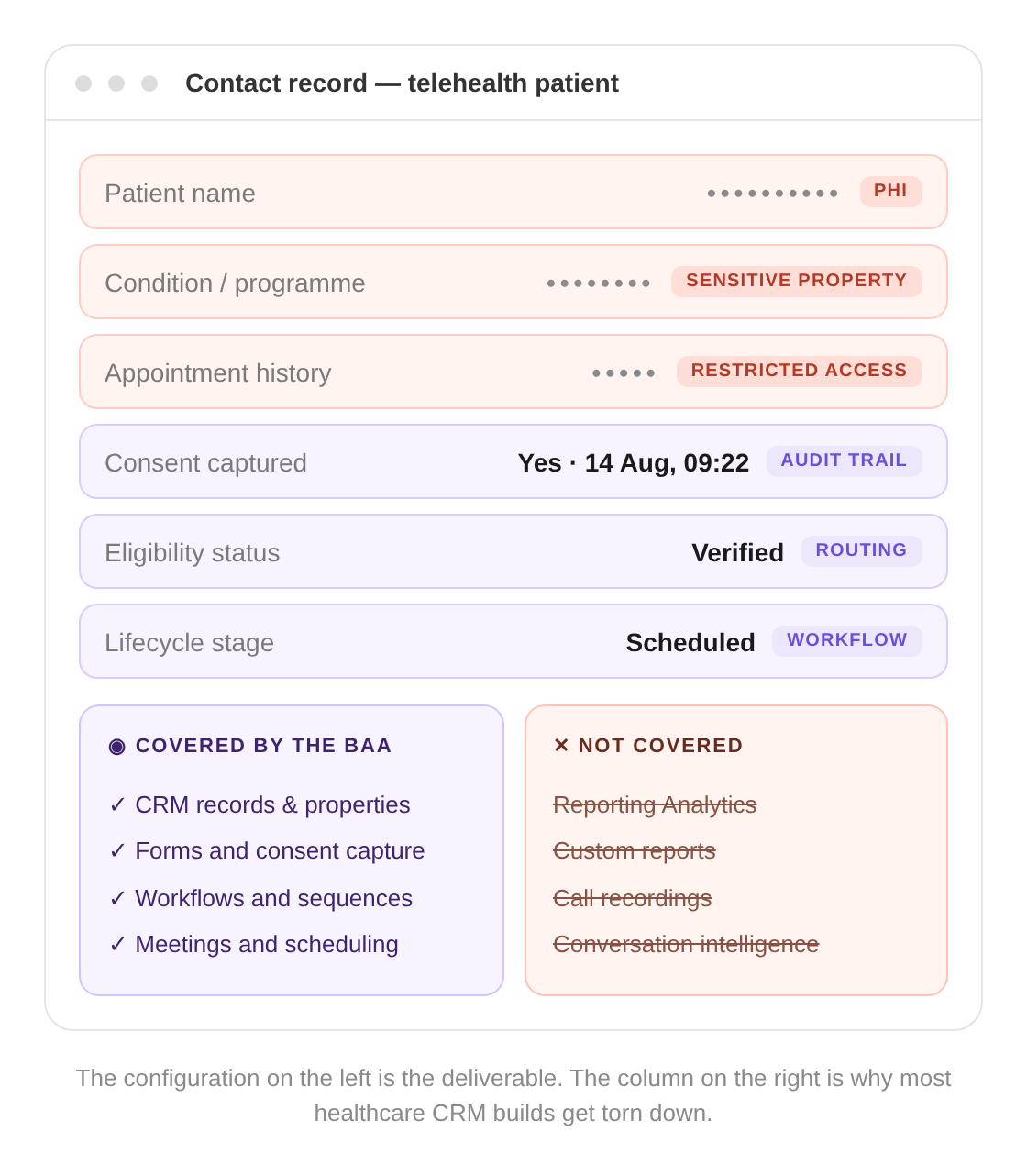
HubSpot's BAA excludes Reporting Analytics, custom reports and call recordings. Knowing that on day one is the difference between a reporting layer that ships and one that gets dismantled. It is the first thing we configure, and it is the reason healthcare teams bring us in rather than doing it internally.
HubSpot for healthcare sub-verticals
Which healthcare sub-verticals need a HubSpot BAA?
A telehealth platform and a medtech manufacturer both need a CRM. They do not need the same one, and the difference is not cosmetic — it is contractual.
Telehealth
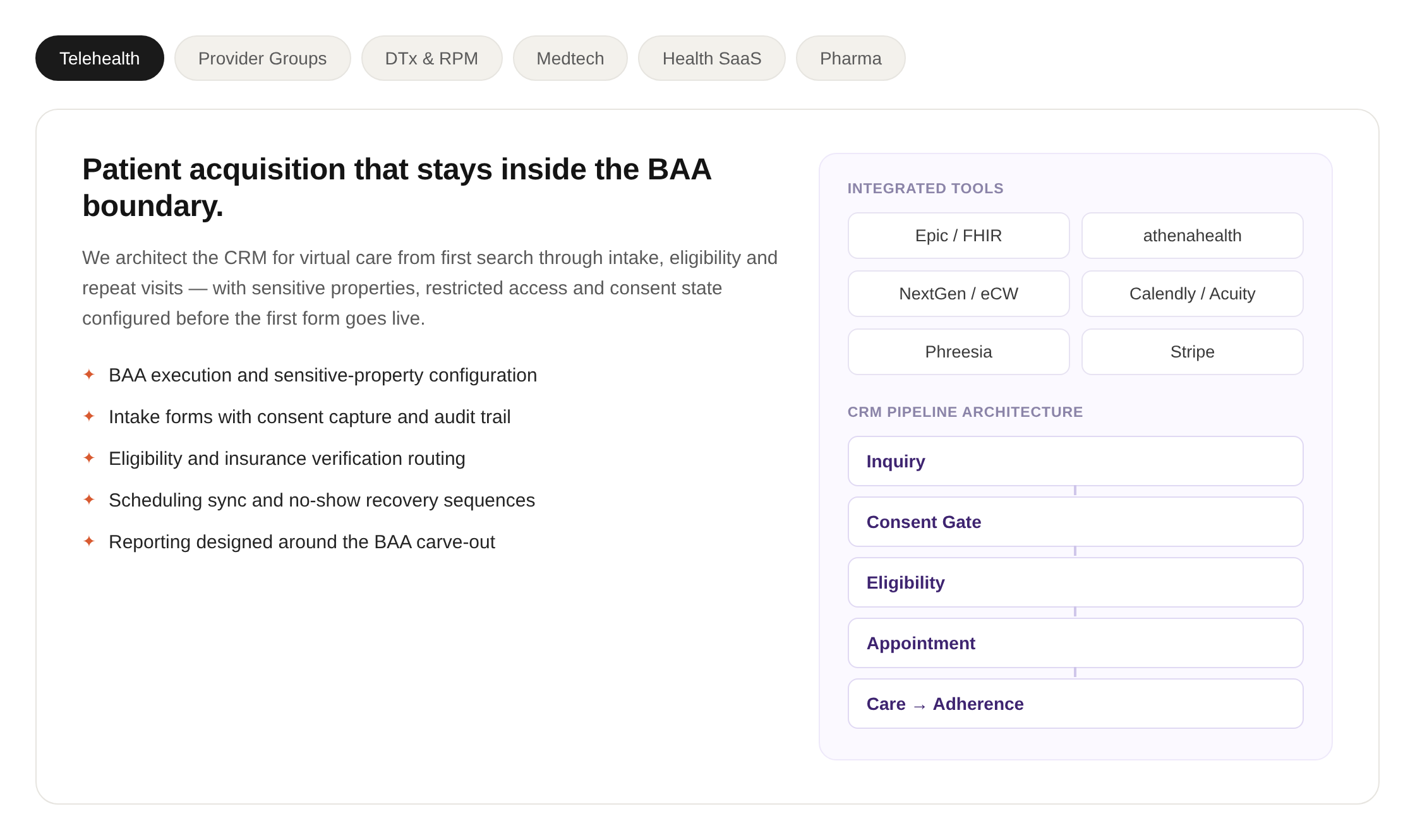
Patient acquisition that stays inside the BAA boundary.
WWe architect the CRM for virtual care from first search through intake, eligibility and repeat visits — with sensitive properties, restricted access and consent state configured before the first form goes live.
- BAA execution and sensitive-property configuration
- Intake forms with consent capture and audit trail
- Eligibility and insurance verification routing
- Scheduling sync and no-show recovery sequences
- Reporting designed around the BAA carve-out
Provider Groups
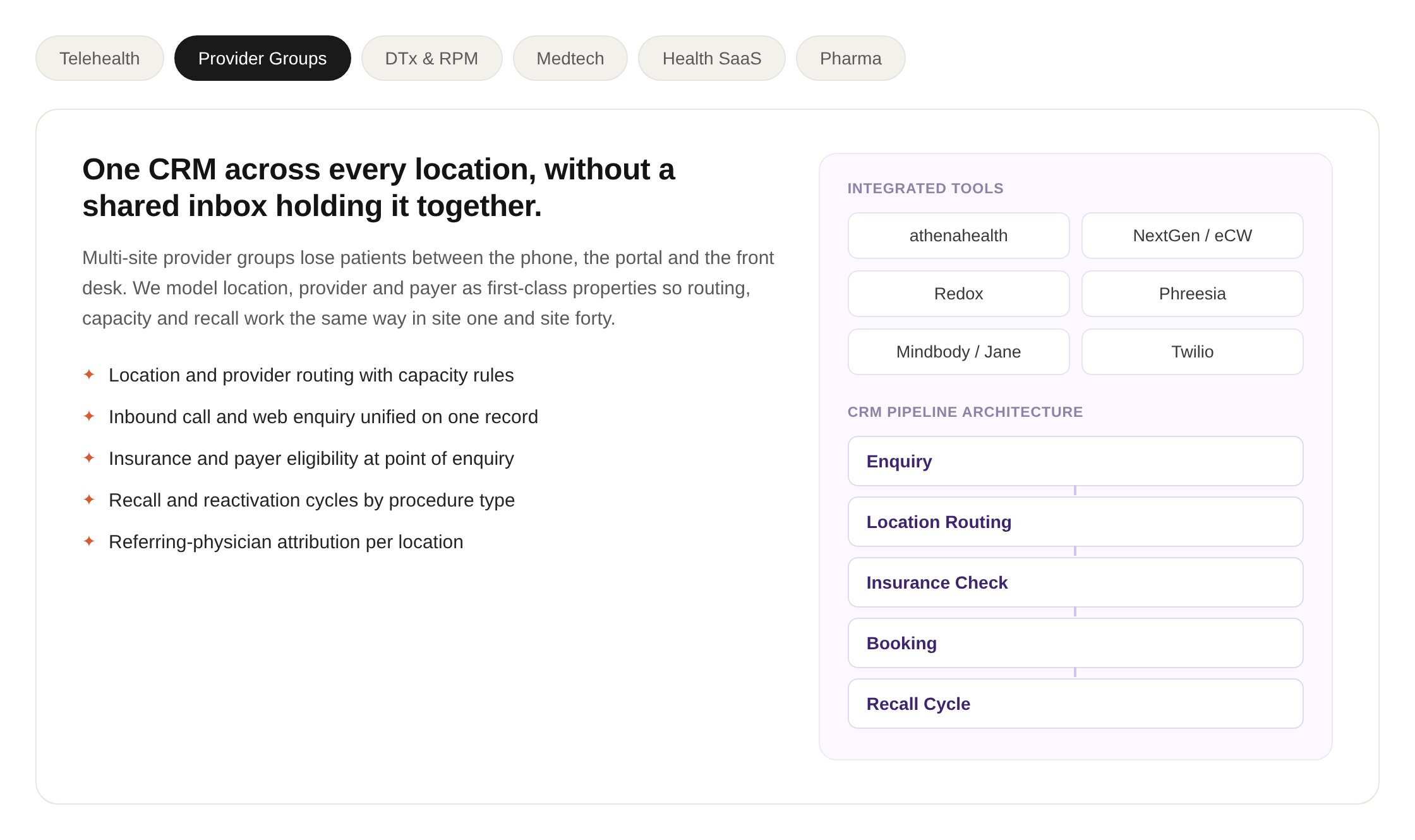
One CRM across every location, without a shared inbox holding it together.
Multi-site provider groups lose patients between the phone, the portal and the front desk. We model location, provider and payer as first-class properties so routing, capacity and recall work the same way in site one and site forty.
- Location and provider routing with capacity rules
- Inbound call and web enquiry unified on one record
- Insurance and payer eligibility at point of enquiry
- Recall and reactivation cycles by procedure type
- Referring-physician attribution per location
DTx & RPM
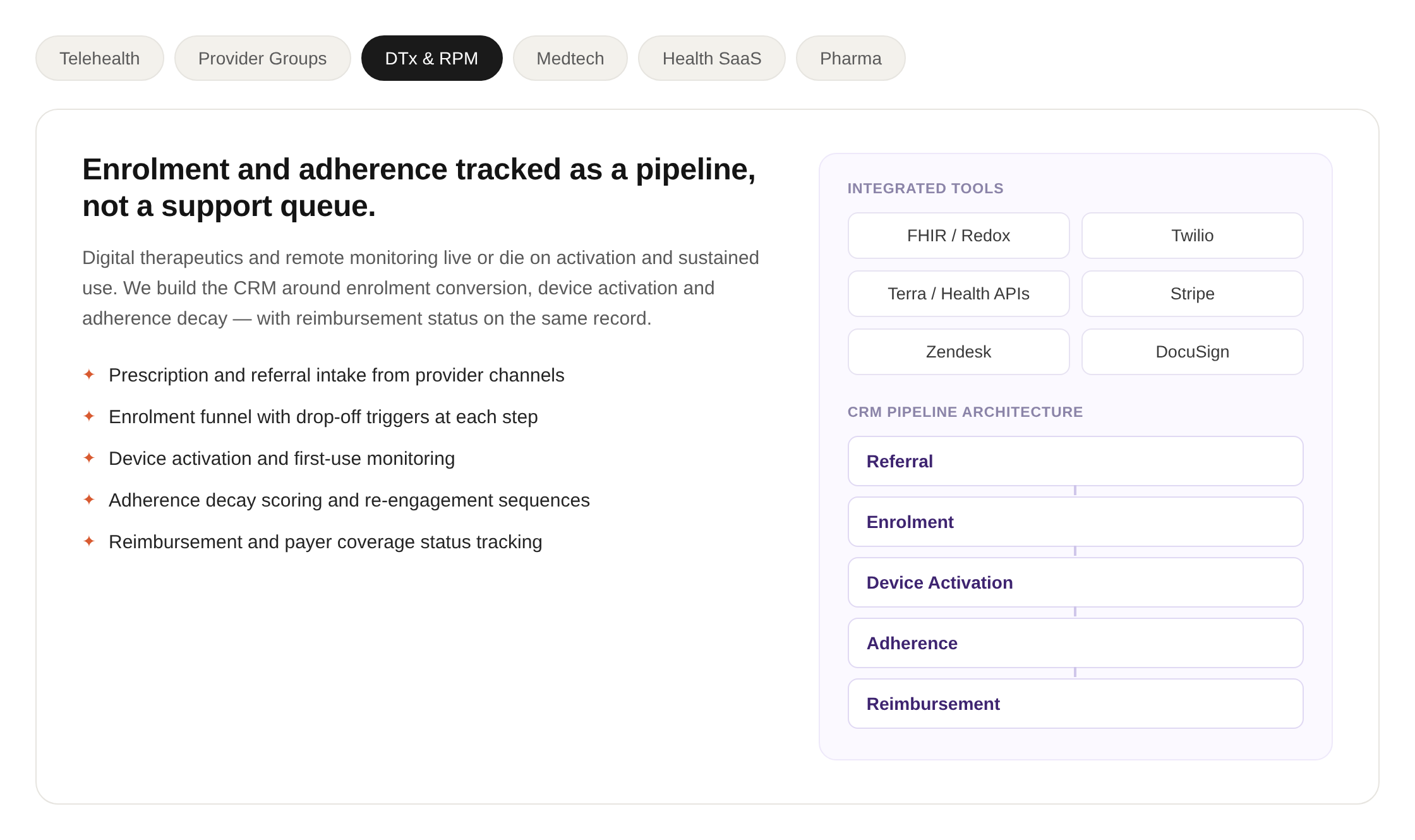
Enrolment and adherence tracked as a pipeline, not a support queue.
Digital therapeutics and remote monitoring live or die on activation and sustained use. We build the CRM around enrolment conversion, device activation and adherence decay — with reimbursement status on the same record.
- Prescription and referral intake from provider channels
- Enrolment funnel with drop-off triggers at each step
- Device activation and first-use monitoring
- Adherence decay scoring and re-engagement sequences
- Reimbursement and payer coverage status tracking
Medtech
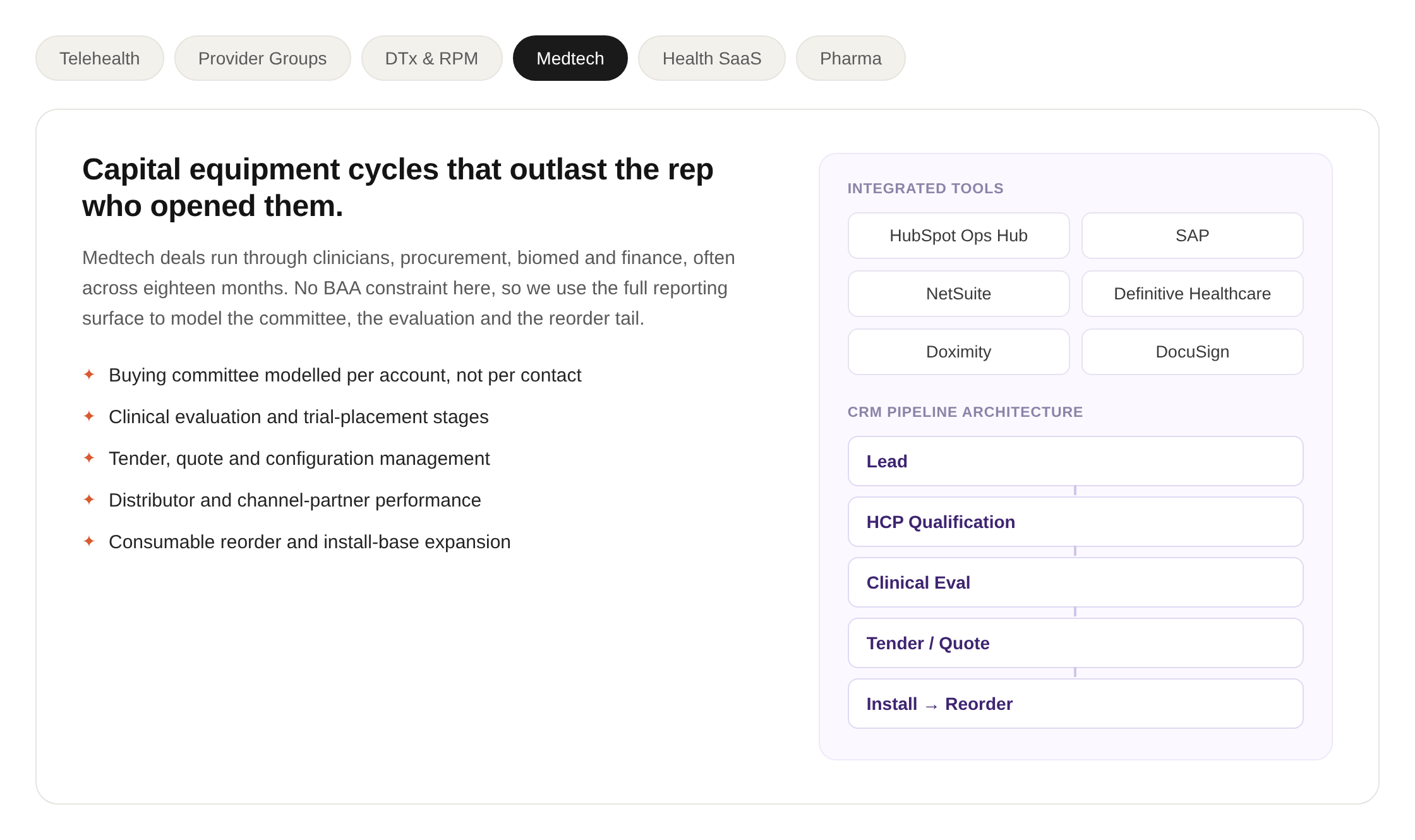
Capital equipment cycles that outlast the rep who opened them.
Medtech deals run through clinicians, procurement, biomed and finance, often across eighteen months. No BAA constraint here, so we use the full reporting surface to model the committee, the evaluation and the reorder tail.
- Buying committee modelled per account, not per contact
- Clinical evaluation and trial-placement stages
- Tender, quote and configuration management
- Distributor and channel-partner performance
- Consumable reorder and install-base expansion
Health SaaS
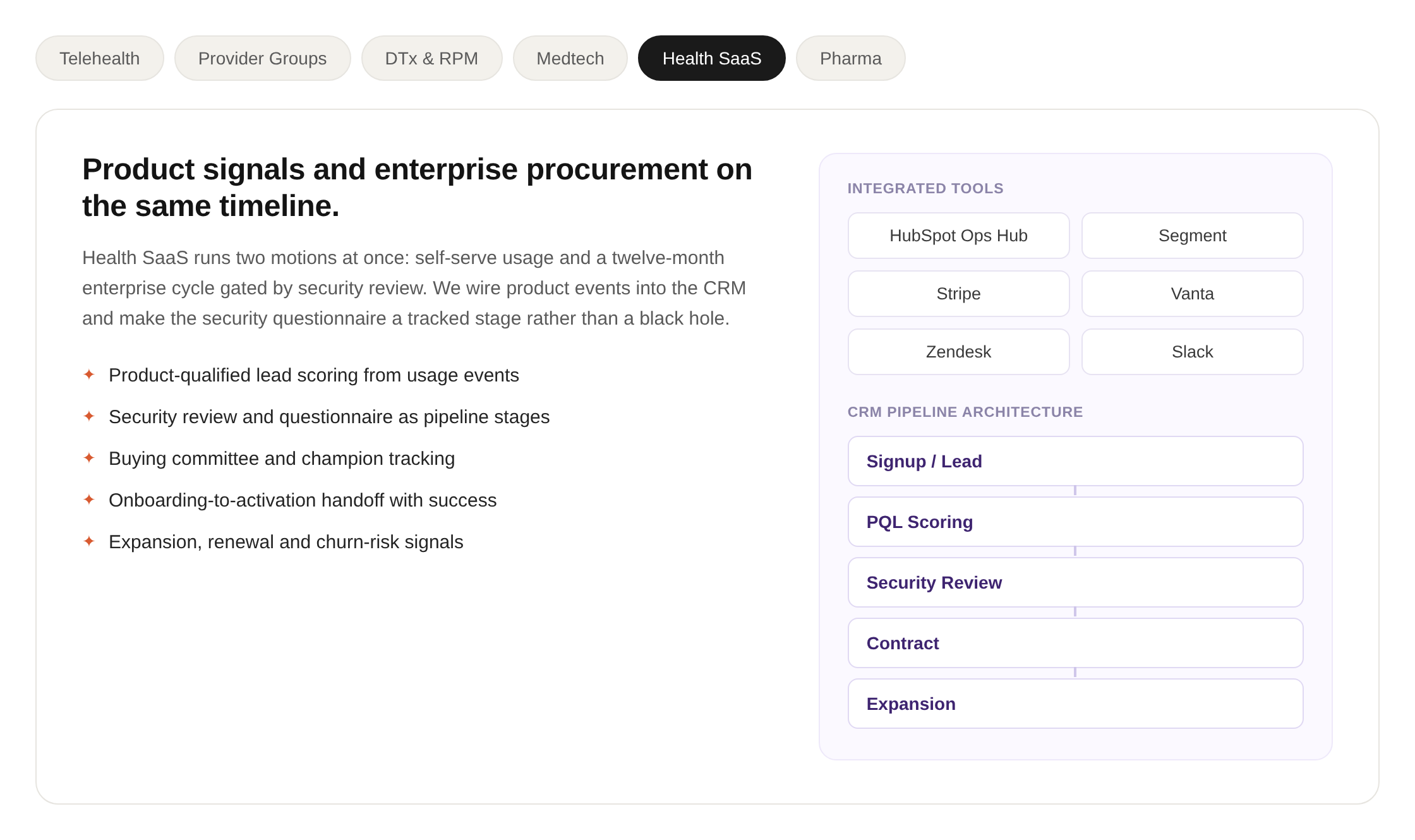
Product signals and enterprise procurement on the same timeline.
Health SaaS runs two motions at once: self-serve usage and a twelve-month enterprise cycle gated by security review. We wire product events into the CRM and make the security questionnaire a tracked stage rather than a black hole.
- Product-qualified lead scoring from usage events
- Security review and questionnaire as pipeline stages
- Buying committee and champion tracking
- Onboarding-to-activation handoff with success
- Expansion, renewal and churn-risk signals
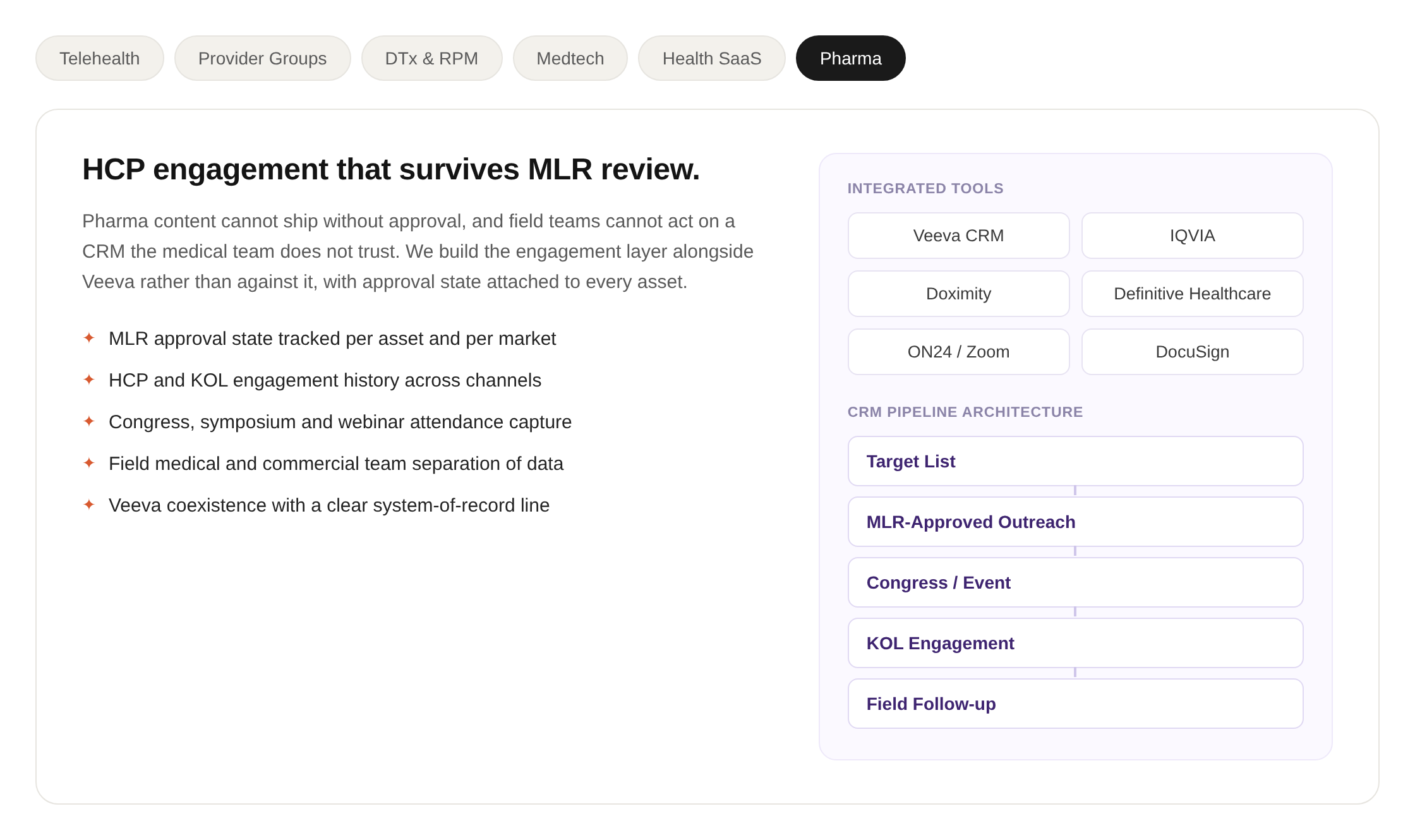
Pharma
HCP engagement that survives MLR review.
Pharma content cannot ship without approval, and field teams cannot act on a CRM the medical team does not trust. We build the engagement layer alongside Veeva rather than against it, with approval state attached to every asset.
- MLR approval state tracked per asset and per market
- HCP and KOL engagement history across channels
- Congress, symposium and webinar attendance capture
- Field medical and commercial team separation of data
- Veeva coexistence with a clear system-of-record line
Four HubSpot healthcare use cases we've productized.
These four come up in nearly every healthcare engagement, on both sides of the PHI line. We've built playbooks, workflow templates and integration blueprints for each.
HIPAA-compliant CRM
/healthcare/hipaa-crm
BAA · sensitive properties · audit
Contract, configuration and access model set up together. Field-level restriction, retention rules, and a reporting layer designed around what the BAA actually covers.
Patient intake automation
/healthcare/intake
Forms · routing · scheduling
Intake that captures consent state, routes on eligibility and payer, books directly into clinical calendars, and recovers no-shows without a coordinator chasing a list.
Referral & provider CRM
/healthcare/referrals
HCP · KOL · network management
Referring physicians modelled as a relationship network rather than a contact list. Source attribution, decay tracking, and KOL engagement history a rep can act on.
Care journey workflows
/healthcare/engagement
Lifecycle · retention · NPS
Post-appointment adherence, recall cycles, and outcome-linked retention. Lifecycle stages that map to care milestones instead of a sales funnel wearing a lab coat.
Tell us where your PHI line sits. We'll tell you what it costs you.
HubSpot healthcare consulting services, scoped four ways.
Fixed scope. Fixed timeline. Fixed price. No retainer ambiguity.
Compliance & architecture diagnostic
Before you build anything · 2 weeks
PHI data-flow map, BAA position, sensitive-property plan, and a written reporting design that respects the carve-out. Delivered as a document your compliance team can sign.
Healthcare CRM implementation
HubSpot Marketing, Sales & Service Hub · 6–10 weeks
Custom objects for providers, referrals and care episodes. Consent state as a first-class property. Intake, eligibility and scheduling wired end to end.
Clinical systems integration
EHR, scheduling, billing · 4–8 weeks
Epic/FHIR, athenahealth, NextGen, Phreesia and Stripe integrated with an explicit boundary: the CRM is the engagement layer, the EHR stays the clinical system of record.
Agent enablement pilot
For teams ready to put agents in production
One agentic workflow live inside the compliance boundary — intake triage, referral follow-up or recall sweeps. Scoped, instrumented, measured against a baseline. Not demoed.
HubSpot EHR integration
How does HubSpot integrate with your EHR?
The CRM is the engagement layer. Your EHR, scheduling, verification and billing systems stay where they are. We architect the connections as one coordinated system.

How long does a HubSpot healthcare implementation take?
No 90-page proposals. No discovery theatre. Compliance work happens first, not last.
Establish what touches patient data. BAA position and access model agreed in writing.
Define which behaviours drive routing, scoring and recall — inside the boundary.
EHR, scheduling and billing connections specced before a line of config is written.
Phased build. Weekly reviews. 30 days hypercare post-launch.
Signs your HubSpot healthcare setup needs rebuilding.
If more than one of these is true, your CRM isn't broken — it was configured before anyone asked where the PHI line sat.

Patient data is in the CRM and nobody can point to the BAA.
The forms went live before the contract did. Every record since is exposure.

Your best dashboard is the one you're not allowed to have.
Reporting Analytics and call recordings sit outside the BAA. Someone built on them anyway.
Referring physicians live in a spreadsheet.
Your highest-value relationships have no owner, no history and no decay tracking.
Same platform.
Completely different outcome.
HubSpot gives you the licence. What you do with it in healthcare is the entire difference between a compliant revenue engine and an expensive contact database.
Compliance posture
A BAA you signed and a settings page nobody configured.
Executed BAA, sensitive properties, restricted access and a documented data-flow map your compliance team signs off.
Reporting
Dashboards built on tools the BAA excludes, discovered at audit.
A reporting layer designed around the carve-out from day one. Nothing gets built that has to come down.
Patient intake
A form that emails a coordinator who chases from a spreadsheet.
Consent captured, eligibility routed, appointment booked, no-shows recovered — without a human in the loop.
Referral network
Referring physicians stored as contacts with a job title.
A modelled provider network with source attribution, decay tracking and KOL history your reps act on.
EHR connection
A Zapier chain that breaks on the next API release.
Epic, athenahealth or NextGen via FHIR or Redox, scoped so the CRM stays the engagement layer.
Time to value
Nine months of internal debate, then a rebuild.
Live in six to ten weeks, with 30 days hypercare after launch.
Compliance posture
A BAA you signed and a settings page nobody configured.
Executed BAA, sensitive properties, restricted access and a documented data-flow map your compliance team signs off.
Reporting
Dashboards built on tools the BAA excludes, discovered at audit.
A reporting layer designed around the carve-out from day one. Nothing gets built that has to come down.
Patient intake
A form that emails a coordinator who chases from a spreadsheet.
Consent captured, eligibility routed, appointment booked, no-shows recovered — without a human in the loop.
Referral network
Referring physicians stored as contacts with a job title.
A modelled provider network with source attribution, decay tracking and KOL history your reps act on.
EHR connection
A Zapier chain that breaks on the next API release.
Epic, athenahealth or NextGen via FHIR or Redox, scoped so the CRM stays the engagement layer.
Time to value
Nine months of internal debate, then a rebuild.
Live in six to ten weeks, with 30 days hypercare after launch.
Not sure whether your CRM setup is actually covered?
What the healthcare CRM rebuild delivered in 8 weeks.

[Client quote pending sign-off. Placeholder shape only — do not ship invented copy.]
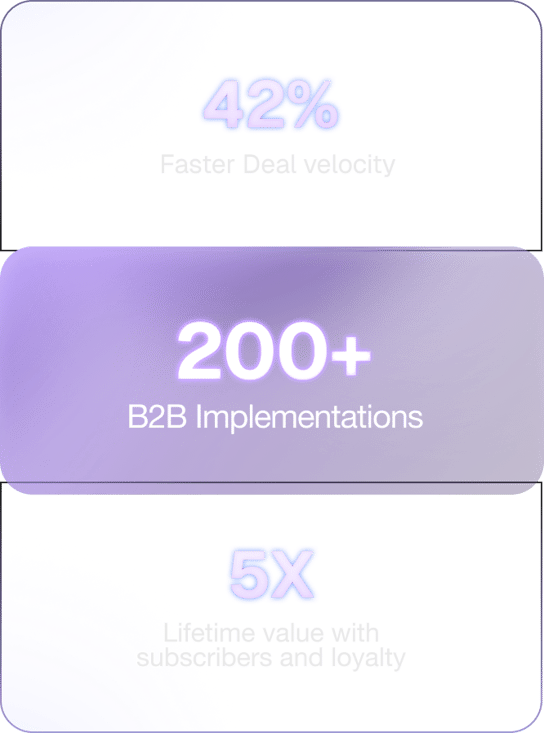
42%
funded deal.
3.1X
across every account.
0
Down from 14.
What you walk away with
-
A HubSpot instance covered by an executed BAA, with sensitive properties and access controls configured and documented.
-
Patient intake running end to end — consent, eligibility, booking and no-show recovery — without a coordinator chasing a list.
-
A referral and provider network your reps can actually work, with attribution and engagement history on every record.
-
Reporting that survives audit, EHR integration that survives the next API release, and 30 days of hypercare after go-live.
HubSpot for healthcare questions we get asked most.
HubSpot supports HIPAA compliance on qualifying subscriptions with an executed Business Associate Agreement, sensitive-data properties and restricted field access. The platform provides the capability. Configuring it correctly is the work, and it is what we do.
Yes. We connect HubSpot to Epic, athenahealth and NextGen through FHIR APIs or an interoperability layer such as Redox. The CRM holds engagement data, the EHR stays the clinical system of record, and the boundary is documented before anything is built.
Generally no. Medtech manufacturers, health SaaS platforms and pharma companies sell to institutions rather than patients, so no protected health information enters the CRM. These teams keep the full reporting, attribution and conversation intelligence surface.
Six to ten weeks from kickoff to go-live, with the first two weeks spent on the PHI boundary map and compliance architecture. Clinical system integrations add four to eight weeks depending on the EHR and interoperability layer.
It captures enquiry details, consent state and insurance information through compliant forms, routes each record by eligibility and payer, books directly into clinical calendars and recovers no-shows automatically. Coordinators stop chasing and start handling exceptions.
HubSpot healthcare guides from our delivery team.
Case Study: Integrating Hint Health with HubSpot

Case Study: Driving 24% Lead Growth for Getix Health
Book a HubSpot healthcare consultation.
Thirty minutes with someone who has configured a BAA boundary before. You will leave knowing exactly where your PHI line sits, what it means for your reporting, and what it would take to fix.
- No deck. We audit your setup live and show you the gaps.
- HubSpot Elite Partner with a dedicated healthcare practice.
- SOC 2 Type II and ISO 27001 certified delivery.
- Fixed-scope engagements. No open-ended retainers.
Relatable? We should definitely talk.
All that we’ll cover when we speak:
- Opportunities to increase the ROI of your HubSpot investment
- Your current GTM motions and future roadmap
- Challenges that you face with your overall revenue stack
- Missed revenue opportunities due to gaps in your funnel
- What would "wins" look like for you?