- Share
-

-

Most big agencies pick white-label partners on price, then spend the next year managing the relationship instead of offloading work. This guide covers the three pricing models partners use, the red flags that predict trouble, and the contract terms that decide whether you keep the client or hand them over.
TL;DR
- Three pricing models: cost-plus (simple, fragile), tiered (honest, sustainable), outcomes-based (rare, powerful). Each signals how the partner operates.
- Cheap upfront usually means expensive later, in scope fights, rework, and management time you didn't budget for.
- Outcomes-based pricing only holds up when the partner names their dependencies, not just their upside.
- Contract structure decides everything. True white-label keeps the client yours. Resale hands them over at renewal.
- Start with one project. Measure it. Expand only if it holds.
Why This Matters
I take a lot of these calls. An agency has more demand than capacity, and half an hour to decide whether we're any good.
The first question usually tells me how it will go. Agencies that open with "what's your rate" become the difficult ones, because price becomes the only lens. The ones who ask "what do you need from us" tend to stay for years.
The pricing model a partner offers is information. So is the contract, and how they answer when you ask about a project that went badly.
These are the questions we'd want asked of us.
What Are the 3 White-Label Pricing Models?
White-label partners price one of 3 ways. The model tells you more about how they operate than their pitch deck does.
Model 1: Cost-Plus Markup
Costs plus a 20-40% markup. Quote the total.
-
What it signals: Speed-to-sale. The quote goes out fast because nothing had to be thought through.
-
The problem:
No buffer. When integrations turn out messier than scoped, the partner's margin is already fixed, so the overrun becomes a change request and the change request becomes a negotiation. Cost-plus turns complexity into a fight over who pays for it. -
Works for:
Simple, repeatable builds with locked scope. -
Red flag when:
Anything custom. They're either underestimating or planning to bill you for the difference later.
Model 2: Tiered Service Pricing
Fixed tiers, each with defined scope and support.
-
What it signals: They've done this enough times to know what a tier costs them, and built in margin to absorb the ordinary surprises.
-
The upside:
Scope conversations stay boring. You know what's included, they've priced for overrun, and nobody's incentivised to stretch the timeline.Tier Scope Support included Starter Basic CMS, 5–10 pages, forms 30 days, 5 hours Professional Full CMS, 30–50 pages, 1 integration, automation 60 days, 10 hours Enetrprise Multi-hub, 50+ pages, 2+ integrations, outcomes tracking 6 months, 20 hours -
Works for: Most implementations.
-
Red flag when: They can't say what separates one tier from the next, or the tiers are priced at levels no one could deliver at.
Model 3: Outcomes-Based Pricing
Fee tied to business result: pipeline lift, cycle compression, forecast accuracy.
-
What it signals: Confidence, if it's real. A partner who'll put fee at risk has usually run enough engagements to know their floor.
-
The catch:
It only means something with history behind it. Without data, an outcome promise is just a bigger number with a story attached. -
Works for:
Transformational work, with a partner who has the track record to back it. -
Red flag when:
They pitch outcomes but can't show the spread, including the engagements that underperformed.
The 3 models side by side
| Parameter | Cost Plus | Tiered | Outcome-based |
| Basis - fee | Partner's costs | Defined scope | Business result |
| Who absorbs overrun | You, via, change requests | The partner | Shared |
| Scope conversations | Adversarial | Routine | Depends on depdencies |
| What you can predict | Very little | Cost and scope | neither without history |
| Partner needs | nothing | Repeatable playbooks | Playbooks and Outcome data |
| Best fit | simple, locked scope | Most Implementations | Transformational Work |
| Main risk to you | Death by change request | Underscoping at quote stage | Paying premium for a promise |
How Should You Evaluate White-Label Partner Pricing Economics?
You don't need their margins. You need enough of their cost structure to tell confident pricing from desperate pricing.
Where the money actually goes:
-
Platform licensing: Hubspot pricing varies by hub and tier. Partner discounts scale with volume commitments, and that gap is their baseline margin if they resell at list. Discount past it to win you and they're eating into delivery budget.
- Implementation labour: A full CMS build isn't 40 hours. It's discovery, templates, migration, testing, launch, and the fortnight after launch. Check the quoted fee against that.
- Integrations: Every one that looks simple grows: data mapping, error handling, edge cases, documentation. Flat-rate integration pricing usually means something's getting skipped.
- Post-launch support. "30 days included" sounds generous until twenty tickets arrive. Unpriced support is where partners start cutting corners.
- Overhead. PM, QA, sales, G&A. It's real, and a sustainable partner has priced for it.
What Red Flags Should You Watch For in White-Label Partnerships?
- Drastically underpriced. 40-50% below market means they've misread the scope or they can't sustain it. Both land on you.
- Vague on inclusions."Integrations extra" without defining what's included. That fight is coming, just later.
- No support terms. "30 days support" is meaningless. Good partners quote hours and define what counts.
- Won't show proof. "Trust us" without references or documentation.
- Flat pricing across complexity. The same number for a Starter build and an enterprise multi-hub means they haven't thought about either.
- Won't start small. Partners who need a large contract upfront usually can't earn one incrementally.
True White-Label Vs Resale Agreements
This decides who owns the client, how margin flows, and what you're holding in year two. Most agencies find out which one they signed at renewal.
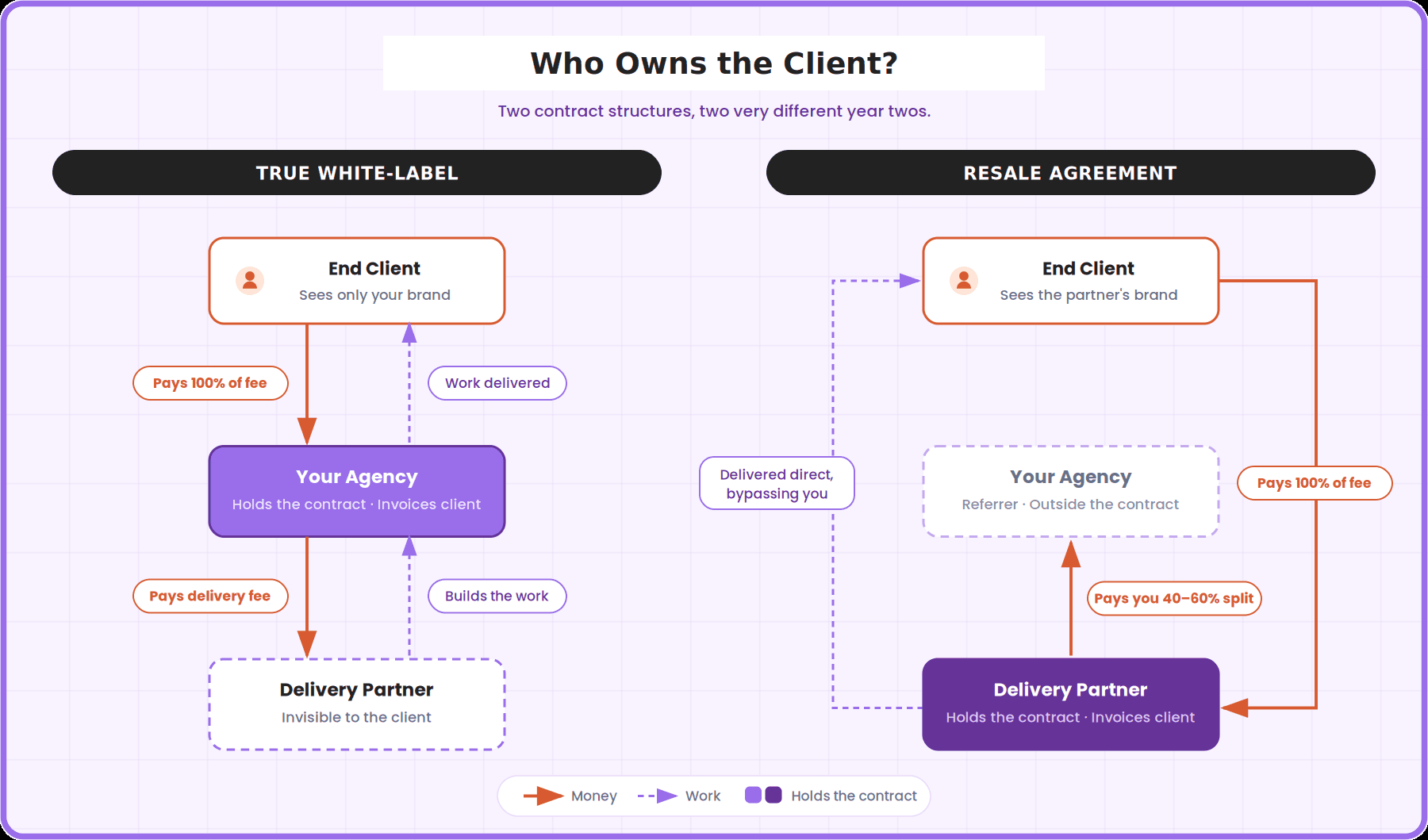
In true white-label, every fee and every conversation routes through you. In resale, the partner sits between you and the client, which is fine until renewal season.
True white-label: you invoice the client, the partner stays invisible, the relationship is yours.
| Advantage | Trade-off |
| 100% margin | You carry delivery risk |
| Renewals and upsells are yours | You carry support liability |
| Compounding revenue | More operational overhead |
Resale: the partner invoices, holds the contract, and pays you 40–60%.
| Advantage | Trade-off |
| Lower delivery risk | You see 40-60%, once |
| Partner handles support | The client becomes theirs |
| Predictable project flow | No renewal or expansion upside |
Agencies arrive at our door mid-engagement having discovered the difference the hard way. The expansion conversation happened between their partner and their client, and they heard about it afterwards.
What Questions Should You Ask a White-Label Partner?
On pricing:
- Walk me through your cost structure. Where does our fee go?
- What's included, what costs extra? In writing.
- How do we handle scope changes? What's the change control process?
- What's your typical timeline, and what causes delays?
On delivery:
- Show me comparable work. May I call those clients?
- What does post-launch support cover, in hours and definitions?
- Have you built this exact thing before, or is this new?
On the relationship:
- What's your accountability if it goes wrong?
- Who's my contact, and what's the escalation path?
- Can we start with a pilot?
What Do Successful White-Label Partnerships Look Like?
They start small. Not a $500K annual commitment. One project. If it holds, expand. If it doesn't, you've bought information cheaply.
They're honest about economics. A partner who says that scope is tight at that budget, here's what we can actually deliver is thinking about year three. The one who says yes to everything is thinking about this quarter.
They measure. Timeline against estimate, satisfaction, resolution time. Even without outcomes-based pricing, a scorecard turns "how's it going" into something you can act on.
They protect the client relationship. Ownership, communication, and escalation defined in the contract, so that when something breaks you're solving it instead of arguing about whose fault it is.
How OneMetric Answers These Questions
Fair play. We've spent this whole article telling you to interrogate partners. Here are our answers to our own checklist.
On who owns the client:
You sign it. We deliver it. Your logo, your invoice, our team under NDA. We don't take renewals, we don't upsell your accounts, and we're not in the room unless you put us there.
On delivery risk:
A dedicated pod per partner, not a slot in a shared vendor pool. Same people, same context, build after build. That's the difference between a partner who learns your standards and one who re-reads your brief every time.
On scope creep:
We build on our own tooling. SuprConfig ships reusable HubSpot assets instead of rebuilding from zero. SuprSwitch handles migrations that would otherwise eat a quarter. Each project starts further along than the last, so overrun risk shrinks instead of compounding.
On proof:
Ask for the Partner Pack. A real handover document, retainer-vs-project breakdown, security pack, and the NDA and MSA you'd actually sign. Not a case study deck. The paperwork.
The part most partners don't offer:
Our specialists join your sales calls before you've won the deal. Scoping, technical validation, the awkward architecture question in minute forty.
You pitch with a solutions architect in the room, and nobody on the other side needs to know whose payroll they're on.
HubSpot Elite Partner, which is invitation-only and fewer than 1% of the ecosystem, and Salesforce Premier Consulting Partner. SOC 2 and ISO 27001. 750+ implementations.
Elite and Diamond partners route work to us, which is either a good sign or a strange one, depending on how you rate your competitors' judgement.