
- Share
-

-

TL;DR
A fintech CRM migration should not begin with an export.
It should begin with agreement on how the business will acquire, qualify, onboard, activate and grow customers after the migration.
Before configuring HubSpot, OneMetric creates an operating blueprint that connects customer stages, business rules, team responsibilities, required data and measurable outcomes.
This blueprint gives business and technical teams something concrete to approve. It also gives the migration team a clear standard against which the new HubSpot environment can be built and tested.
The result is not simply a new CRM containing the old data. It is a working model of how the fintech company intends to operate next.
At a glance
|
Before configuration begins |
What it establishes |
|
Current-state journey map |
Where customers, information and internal handoffs get stuck today |
|
Future-state operating blueprint |
How the company wants the journey to work after migration |
|
Business-rule register |
What must be true before a record can move or an action can occur |
|
Responsibility map |
Which team owns every important decision and handoff |
|
Measurement framework |
How leadership will evaluate performance in the new environment |
|
Acceptance plan |
What must be proven before the company moves to HubSpot |
A fintech CRM migration should begin on a whiteboard
Most migration teams can produce an inventory of objects, properties, workflows and reports.
That inventory explains what exists. It does not explain why it exists, whether teams still use it or whether it supports the company’s current business model.
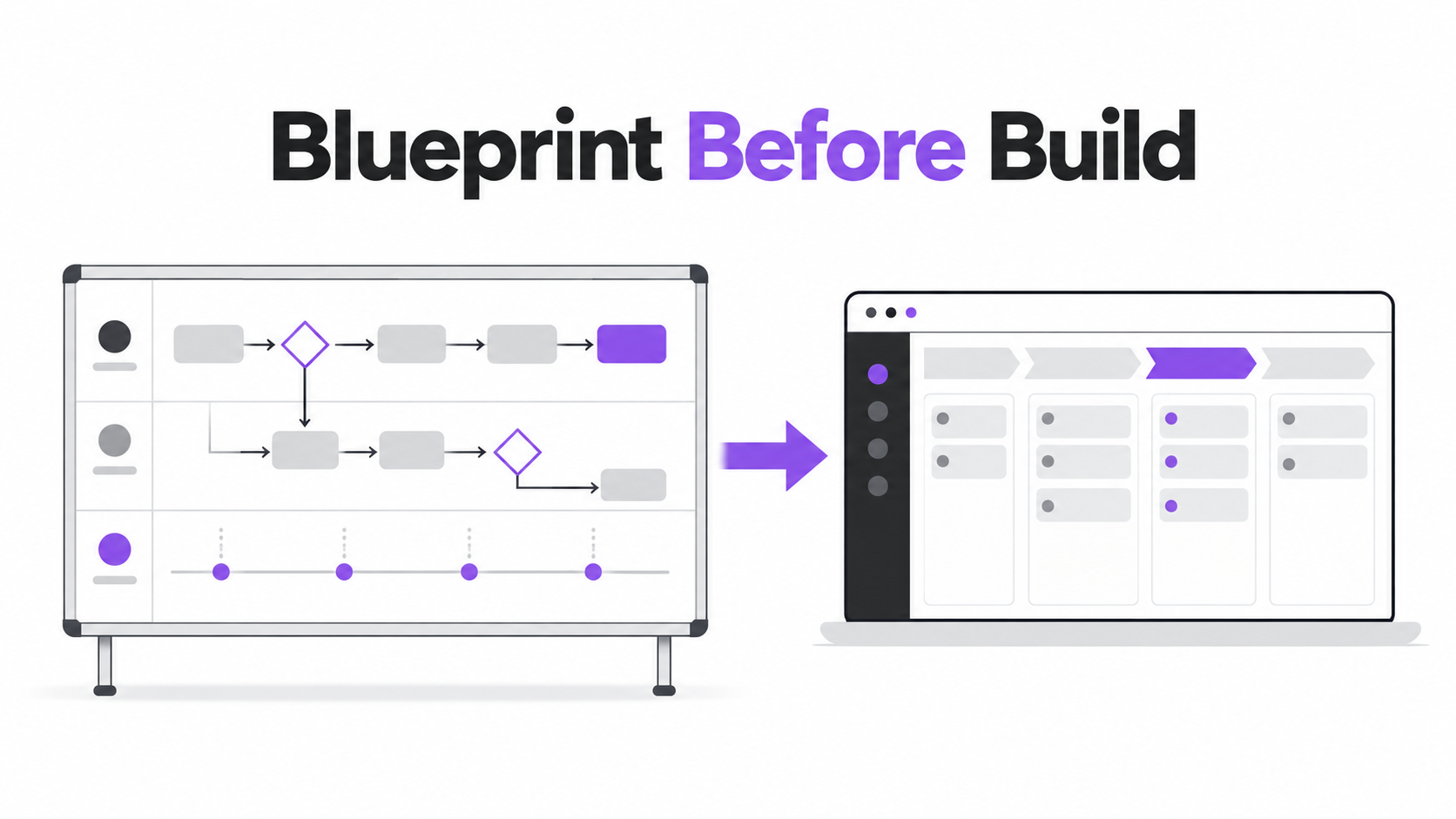
A mature fintech may have introduced new products, entered new regions, added compliance checks or changed its route to market several times since its CRM was first implemented.
The CRM usually carries evidence of every one of those changes.
A pipeline may have been created for a regional team that no longer operates independently. A lifecycle stage may mean something different to marketing and sales. An onboarding status may depend on information maintained outside the CRM. A report may appear important but rely on fields that users no longer update consistently.
This is why OneMetric begins with the operating environment rather than the database.
We map how the work happens today, including the informal work that never became part of the CRM. Only then can we distinguish between the process the company designed and the process employees have created to keep the business moving.
The current process is rarely documented in one place
Ask five teams to describe the same customer journey and you may receive five different answers.
Marketing describes how demand is generated and qualified. Sales explains how commercial potential is evaluated. Compliance focuses on the evidence required for approval. Onboarding tracks what must happen before activation. Customer success thinks about product adoption, risk and expansion.
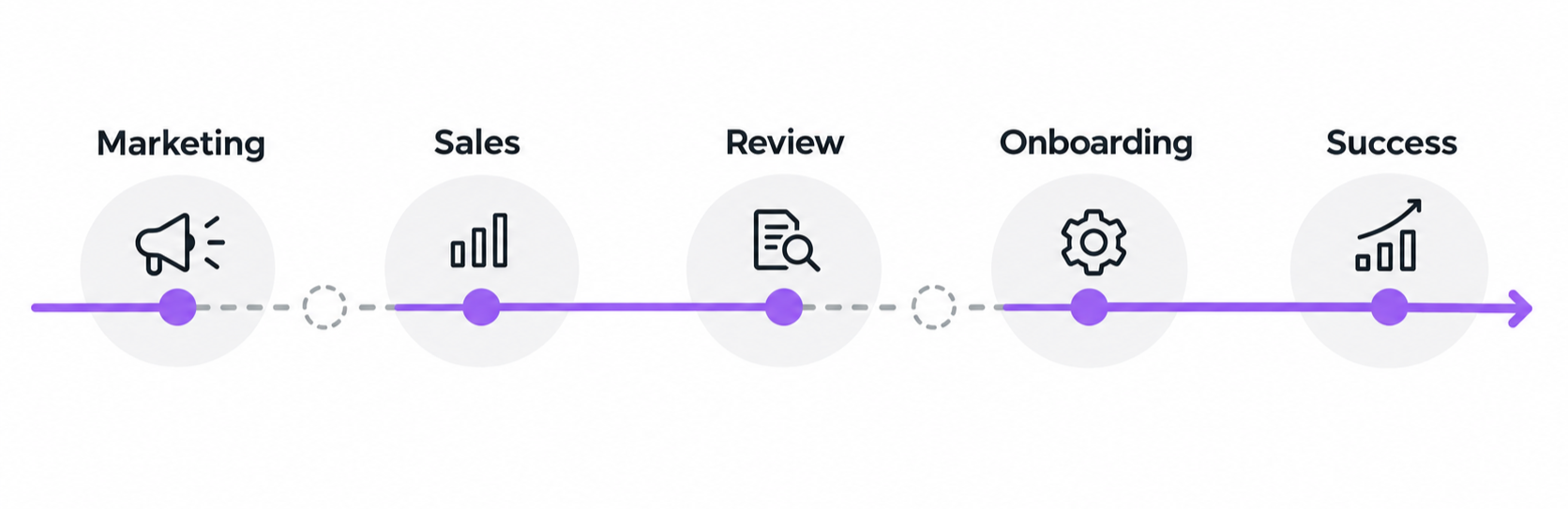
Each answer can be accurate from that team’s perspective.
The problem appears in the space between those answers.
A lead may be considered qualified by marketing but not actionable by sales. A deal may be commercially closed but not ready for onboarding. An account may be activated but lack the product activity required to be considered healthy. A customer may qualify for an additional product without that signal ever reaching the relevant account owner.
These are not field-mapping problems.
They are gaps in the operating model.
A migration creates the right moment to surface those gaps because teams are already being asked to explain what information and processes they need in the future CRM.
OneMetric maps decisions, not just stages
A customer journey diagram can look complete while hiding the most important part of the process: the decision required at each stage.
For example, “application submitted” and “application approved” may appear as consecutive steps. Between them, however, the business may need to validate documents, complete verification, resolve exceptions, confirm eligibility and record approval.
If those decisions are not defined, the CRM team is forced to make assumptions during configuration.
OneMetric adds a decision layer to the journey.
For every meaningful movement, we establish what must have happened, which information is required, who has authority to make the decision and what the next team needs to receive.
This changes the quality of the migration specification.
Instead of asking for a workflow that moves an application when a field changes, the specification explains the business condition represented by that field, the team responsible for it and what should happen when the condition is not met.
HubSpot can then be configured around agreed business logic rather than technical assumptions.
The future state should not be an edited version of the present
Current-state mapping is essential, but it should not dictate the final design.
The existing CRM shows how the company operates within its current limitations. Teams may rely on spreadsheets because the CRM cannot support a process. Managers may manually reassign records because ownership rules are unreliable. Important updates may be shared through Slack or email because the right teams cannot see them in the CRM.
If these workarounds are treated as requirements, the new portal will formalize them.
OneMetric separates current behavior into three categories:
- Processes that work and should be retained
- Business requirements that need a better system response
- Workarounds that should disappear in the future state
This is where operating-model redesign becomes practical.
The objective is not to make every process more sophisticated. It is to remove unnecessary movement, make responsibilities clearer and ensure that important information reaches the right team at the right moment.
The operating blueprint connects seven workstreams
The future-state blueprint is developed across seven connected workstreams: customer movement, decision logic, team responsibility, data requirements, automation, measurement and adoption.
These are not handled as seven independent documents.
A change in one workstream is reviewed against the others.
If the business introduces an additional approval step, the blueprint must show who owns it, what evidence is required, how the outcome is recorded, what happens when approval is delayed and how the delay will appear in reporting.
If a new customer-health threshold is introduced, the blueprint must show which information produces the score, how often it changes, who receives the signal and what action is expected.
This connected view prevents teams from approving a process that cannot be implemented, measured or maintained.
It also gives technical teams the context required to make better architectural decisions later.
What OneMetric’s operating blueprint contains
The blueprint is not a presentation that disappears after discovery. It becomes the reference point for configuration, testing and stakeholder approval.
|
Blueprint component |
Practical purpose |
|
Journey map |
Shows how each customer type moves from initial interest to ongoing value |
|
Stage definitions |
Removes conflicting interpretations across teams |
|
Decision register |
Documents the rule and evidence behind every important movement |
|
Responsibility map |
Identifies the owner, contributor and recipient at each handoff |
|
Data requirements |
Connects every required data point with a business decision or report |
|
Measurement model |
Defines how conversion, velocity, activation and expansion will be evaluated |
|
Exception paths |
Explains what happens when the standard journey cannot continue |
|
Acceptance scenarios |
Converts the blueprint into real situations that must work before launch |
This is more useful than a long requirements document because stakeholders can follow a customer through the proposed operating model and identify missing decisions before the build begins.
A real fintech redesign started with process visibility
A leading fintech approached OneMetric because its HubSpot environment was not creating enough value.
The company had two connected problems: an absence of coherent revenue processes and data that could not support meaningful interpretation.
Marketing had limited visibility into what happened after lead generation. Opportunity management lacked structure. Customer onboarding was unclear. The company could not reliably evaluate marketing and sales performance across monthly or quarterly periods.
OneMetric did not begin by adding automation.
We ran a three-week discovery with regional sales teams, marketing leadership, onboarding and customer success. Together, we created a visual representation of the customer journey and defined the information the business needed to understand it.
That included operational data such as transaction volume, licence status, sub-industry and payment corridors.
With the operating model defined, OneMetric cleaned and enriched the database, introduced shared lifecycle and lead-status definitions and built marketing journeys around actual customer conditions.
The work then extended beyond acquisition.
Transaction information was connected with closed-won customer records to create customer-health classifications. Those classifications allowed the company to distinguish between healthy customers, accounts requiring attention and customers ready for cross-selling.
The outcome was measurable.
Lead-to-MQL conversion increased by 150%. The sales pipeline grew by 20%. Customer lifetime value increased by 15%, while timely alerts and clearer upgrade journeys helped save up to 15 days in the process.
The technology created value because the customer journey, data model and business decisions had been defined first.
See how OneMetric rebuilt the customer journey and data model for a leading fintech.

|
Configuration should follow the order of business dependency
Once the blueprint is approved, the HubSpot build should not be organized around whichever feature is easiest to configure first.
It should follow the order in which the business depends on the system.
The foundation comes first: shared definitions, record relationships and the information required to support decisions.
Customer movement comes next. Pipelines, lifecycle stages and responsibility rules are configured around the approved journey.
Automation follows only after the underlying conditions and ownership are stable.
Reporting comes after the business agrees on what each stage, conversion and outcome means.
This order matters because automation can hide a weak process. A workflow may execute perfectly while acting on an unclear status or sending work to a team that has not accepted responsibility for it.
OneMetric treats configuration as the implementation of the blueprint, not as a separate technical exercise.
A fintech migration needs approval gates
A migration should not move directly from discovery to build and then to launch.
OneMetric uses approval gates to prevent unresolved business decisions from becoming configuration defects.
|
Approval gate |
What must be demonstrated |
|
Operating-model approval |
Business leaders agree on the future customer journey and responsibilities |
|
Design approval |
Business requirements have been translated into a workable HubSpot design |
|
Scenario approval |
Real customer and internal-team situations behave as expected |
|
Cutover approval |
Data, users, processes and reporting are ready to operate together |
A gate is not passed because a document was delivered.
It is passed when the relevant stakeholders can review the proposed model, test the agreed scenarios and confirm that the system supports the intended way of working.
This gives migration governance a business purpose.
It also stops important questions from being deferred until user acceptance testing, when structural changes become more expensive.
Test a working day, not isolated workflows
Traditional testing often evaluates individual components.
A form creates a contact. A workflow assigns an owner. A notification is sent. A dashboard displays a result.
All four tests may pass while the full customer journey still fails.
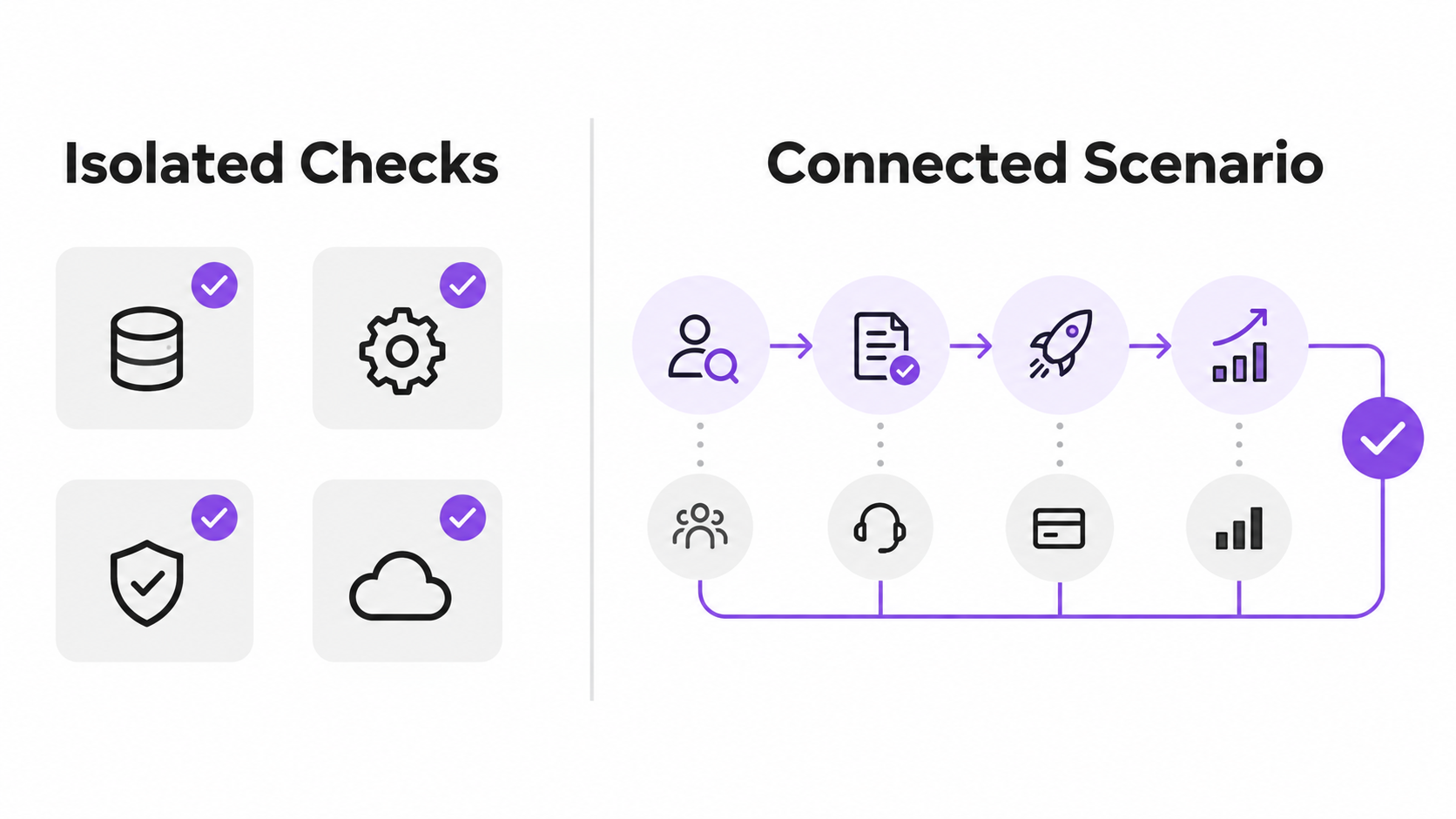
OneMetric uses connected business scenarios to validate the new environment.
Consider a qualified prospect who applies for a product, requires additional documentation, clears review, becomes active and later shows potential for an upgrade.
The test should follow that customer across teams.
Did sales receive the right context? Did onboarding understand what was already completed? Was the exception handled without losing ownership? Did the activation outcome appear correctly? Was the expansion signal visible to the right team?
This type of testing shows whether the operating model works across HubSpot, connected systems and human handoffs.
It also gives users a clearer way to validate the system because they are testing situations they recognize from their work.
The migration is ready when teams can explain how work will happen
A technically complete portal is not automatically ready for cutover.
Before launch, marketing should be able to explain how qualified demand reaches sales. Sales should understand what information is required before an opportunity progresses. Onboarding should know exactly when responsibility moves and what context accompanies it. Customer success should see the conditions that require intervention or expansion activity.
Leadership should be able to follow the same journey through reporting.
If those explanations remain inconsistent, more configuration will not solve the problem. The operating model still requires alignment.
OneMetric uses this standard because user adoption depends on clarity.
People are more likely to use a CRM when its stages, responsibilities and actions reflect an operating model they understand and helped validate.
Why OneMetric leads with operating-model design
OneMetric holds HubSpot accreditations across Data Migration, CRM Implementation and Custom Integration. We are also a HubSpot Elite Solutions Partner and a Financial Services Industry Specialist.
For this type of engagement, the value is not in listing those credentials separately.
The value is in bringing the capabilities together.
A fintech migration requires structured discovery, future-state CRM design, data preparation, technical execution, testing and adoption. Separating those responsibilities across disconnected partners increases the risk that business decisions will be lost between strategy and implementation.
OneMetric keeps the operating blueprint connected to the final HubSpot environment.
The team that understands why the process was designed also understands how it should be configured and how its success should be tested.
|
Your future HubSpot portal should reflect the fintech business you are building, not the CRM structure you are leaving behind. 
|
What leadership should see before approving cutover
A leadership team does not need to review every property or workflow.
It should, however, have a clear view of the operating model being activated.
The cutover review should demonstrate how priority customer journeys will work, where important decisions occur, which teams own them and how performance will be measured.
It should also surface unresolved exceptions.
What happens when required information is missing? What happens when an application remains in review beyond the expected period? What happens when no owner accepts a handoff? What happens when a customer shows strong product activity but has no active commercial opportunity?
These scenarios reveal whether the design can support real operations rather than only the standard path.
A fintech CRM migration is ready when leadership can see how the company will operate, teams can explain their responsibilities and the new system can support both the expected journey and its exceptions.
That is the outcome OneMetric designs before the migration goes live.
Read also
What Fintechs Should Migrate, Rebuild or Retire When Moving From Salesforce to HubSpot