
- Share
-

-

About Keysight and the DES Division
Keysight Technologies is an S&P 500 company and a global leader in electronic design and test solutions. The company operates as a global enterprise headquartered in the United States and supports customers across every major engineering and R&D market.
Inside Keysight, the Design Engineering Systems (DES) division was expanding through a series of acquisitions, bringing in brands like ESI, EDA, and Cliosoft.
But each business unit followed its own go-to-market model, including high-volume inbound programs, enterprise sales cycles, PLG motions, and multi-product solution sales. All three brands used different marketing automation platforms and different Salesforce setups, which made alignment difficult after the acquisitions.
So, to unify DES operations, Keysight chose HubSpot as the centralized marketing platform and committed to consolidating sales activity inside the corporate Salesforce instance.
And OneMetric was brought in to design the architecture, lead the migrations, and make sure that every brand continued operating smoothly throughout the transition.
The Operational Challenges Behind the Consolidation
1. Fragmented Martech Across Multiple Acquisitions
DES inherited three different marketing automation platforms. ESI operated on Pardot, EDA and Cliosoft were on Eloqua, and Eggplant had a separate HubSpot portal with its own assets and routing logic.
Each setup used different scoring rules, form structures, automation paths, and audience segments. None of the systems communicated with each other, which made standardizing campaigns, reporting, and lead lifecycles nearly impossible.
2. Multiple Salesforce Orgs With Conflicting Data Models
ESI had its own Salesforce environment, while the other DES brands were connected to Keysight Salesforce. Field names, object structures, routing rules, and lifecycle logic were not aligned across these orgs.
These differences created sync errors, duplicate records, and inconsistent handoff behaviour. Any consolidated HubSpot instance needed to integrate with more than one Salesforce org at the same time.
3. Non-standardized Lead Lifecycles and MQL Definitions
Each brand followed its own definitions for inquiry, MQL, SAL, and SQL. Some relied on scoring thresholds, others used manual qualification, and some tied their process to specific forms.
The absence of a shared lifecycle framework meant cross-brand reporting was inconsistent, and leadership had no reliable way to measure pipeline quality or performance across DES.
4. Conflicting Lead and Form Submission Logic
ESI and Eggplant followed a one-contact and one-lead model where Salesforce only received new leads after a clear MQL event. This created a predictable handoff pattern for sales.
EDA and Cliosoft followed the opposite model, where every form submission created a new Salesforce lead. HubSpot cannot support both models natively, which created a major architectural challenge.
5. High Operational Cost and Maintenance Overhead
Running Pardot, Eloqua, and multiple HubSpot portals required separate administration, automation updates, and reporting maintenance across platforms. Each system had to be managed independently.
Licensing created unnecessary costs and slowed down execution because every update had to be replicated. Maintaining three platforms made it harder for DES to launch campaigns at the pace they needed.
6. No Unified Reporting or Attribution Model
Each brand tracked performance differently. ESI measured task-based activity in Salesforce, EDA, and Cliosoft reported through Eloqua, and Eggplant used HubSpot for analytics.
Attribution rules, channel definitions, and conversion points were not aligned. Leadership had no consolidated view of how DES was performing, which made prioritizing campaigns difficult.
7. High Technical Complexity Across Integrations and Data Models
The transition required migrating Pardot, Eloqua, legacy MAPs, and multiple HubSpot portals into a single instance while keeping both Salesforce orgs active. Each integration had different routing rules.
Sync governance had to be tightly controlled to prevent duplicate Salesforce records. Data models needed full alignment before migration could begin, including field mappings, lead sources, and lifecycle stages.
Unifying Marketing and Salesforce Operations Across DES
1. Discovery and Architecture
We began by auditing every system across DES, including Pardot, Eloqua, legacy HubSpot portals, AEM form submissions, Jitterbit flows, and two separate Salesforce orgs.
For each brand, we documented how leads were created, how forms behaved, how routing was triggered, and how historical scoring logic influenced nurture programs. This provided a complete map of how marketing and sales operated across three acquired companies.
Using this information, we designed a unified HubSpot architecture that could support multiple lead models, multiple Salesforce orgs, and brand-specific requirements. The blueprint defined lifecycle stages, brand tagging rules, custom object structures, routing pathways, and sync logic.
It also outlined how both Salesforce orgs would remain active during migration without creating data conflicts.
Key Architectural Wins
• Full cross-platform audit covering 15 years of Pardot and Eloqua logic
• One architecture that could run two Salesforce orgs in parallel
• BU aware structure designed to onboard future acquisitions without rework
2. Data Model Standardization
The next step was building a single data model that all DES brands could align to. We standardized field names, picklist values, lifecycle statuses, assignment rules, routing conditions, and lead source taxonomies.
This eliminated conflicting definitions and prevented sync errors between HubSpot and both Salesforce orgs.
We also created the unified lifecycle framework for inquiry, MQL, SAL, and SQL, with brand variations built into the model. This allowed different BUs to maintain their operating logic while contributing to a centralized reporting structure.
Standardization Achievements
• All lifecycle, routing, and lead source fields aligned across all brands
• Complete consolidation of duplicate and outdated fields
• One data model ready for Pardot, Eloqua, and HubSpot migrations
3. Marketing Asset Migration
Once the data model was ready, we began migrating more than 180 Eloqua and Pardot assets. Each asset was reviewed, cataloged, and rebuilt inside HubSpot so it matched the new structure. This included forms, emails, segmentation lists, landing pages, and nurture paths that had been refined across years of acquisition growth.
We also translated long-standing Eloqua conditional logic, scoring mechanisms, and audience filters into scalable HubSpot workflows. This work ensured that historical marketing behaviour carried forward without loss of intent or downstream attribution.
Migration Highlights
• 180 plus assets rebuilt and standardized inside HubSpot
• Legacy Eloqua and Pardot logic preserved through accurate workflow translation
• All assets now operate inside one scalable MAP
4. Salesforce Integration Redesign
The new HubSpot instance was connected to Keysight Salesforce as the primary CRM, while keeping Eggplant Salesforce active through a temporary sync. Both integrations required separate routing rules, field mappings, lifecycle models, and duplicate prevention logic, so no conflicts occurred.
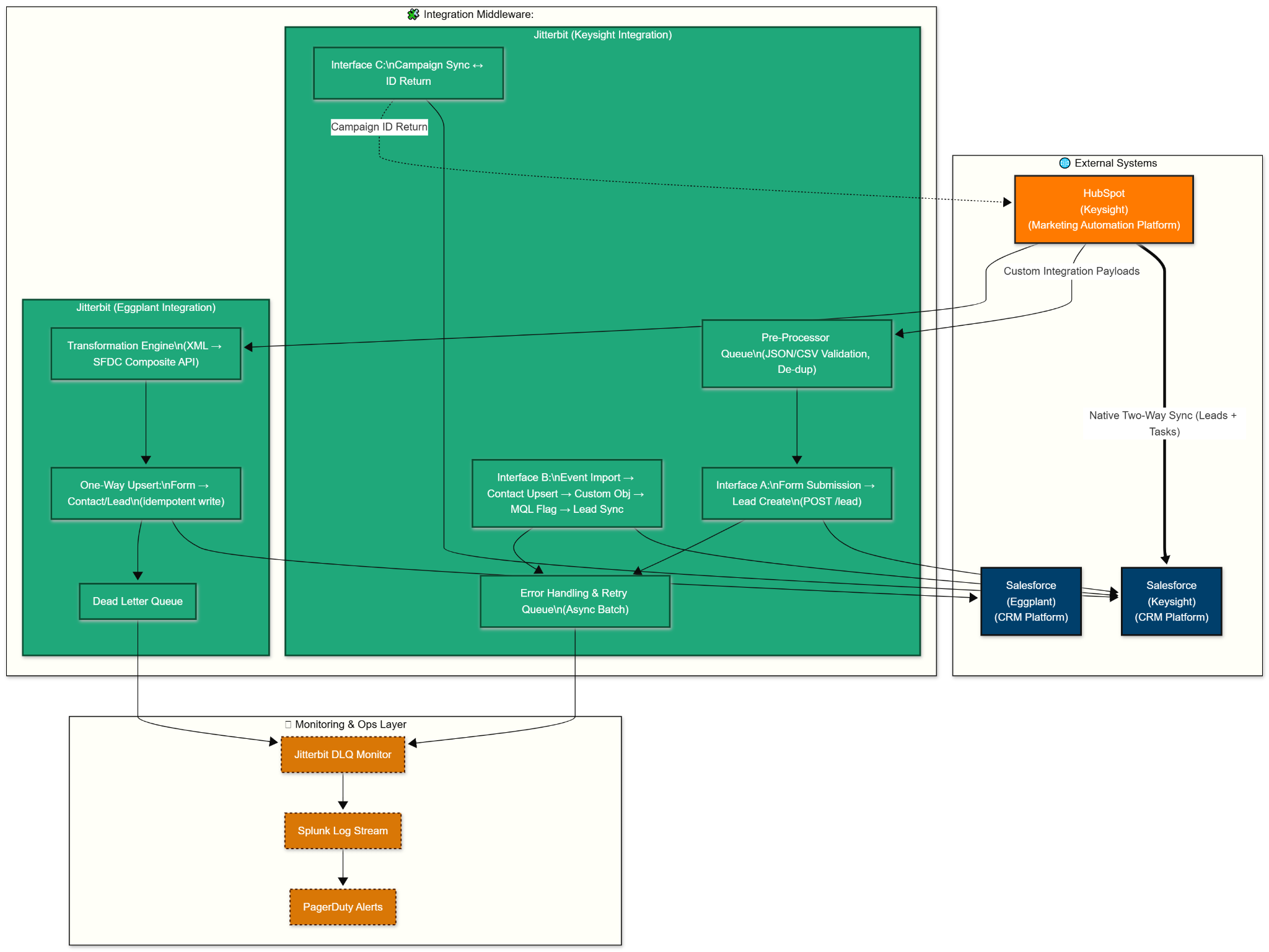
To support DES’s two different lead creation models, we implemented a hybrid integration. For ESI and Eggplant, HubSpot only synced MQL-ready records into Salesforce.
For EDA and Cliosoft, each form submission was captured in a custom object and passed to Salesforce as a new lead through Jitterbit.
Integration Advancements
• HubSpot syncing to two Salesforce orgs without any data collisions
• Hybrid integration supporting both MQL-gated and multi-lead models
• Custom sync rules preventing cross-brand contamination or record duplication
5. Lead Lifecycle and Routing Deployment
We deployed the unified lifecycle across DES using brand tagging embedded directly into every form submission. This ensured that workflows, routing paths, and MQL logic were all brand-specific and isolated from each other. No submission from one brand could trigger logic from another.
Routing workflows were rebuilt to support both lead models. This included brand routing queues, owner assignment automation, task creation rules, and submission-level error handling. Each workflow was tested to confirm submissions entered the correct Salesforce org with accurate segmentation and no duplicates.
Routing Enhancements
• Brand-tagged routing ensuring perfect separation between BUs
• Complete rebuild of routing queues for both lead models
• Fully validated lifecycle movements across three acquired brands
6. Rollout and Cross-Brand Testing
Before cutover, we conducted full cross-brand validation. This included live submissions from AEM, Eloqua remnants, Pardot remnants, and legacy HubSpot portals to confirm that every form flowed into HubSpot and then into the correct Salesforce org. We checked mappings, tasks, Jitterbit lead creation, lifecycle advancement, and historical asset behaviour.
Once testing passed, all DES brands were fully live inside a single HubSpot instance with unified Salesforce routing, standardized lifecycle definitions, consolidated lead sources, and centralized reporting. This replaced all legacy MAPs without losing a single submission or historical record.
Rollout Successes
• Zero data loss across all migrations
• Two Salesforce orgs unified into one routing model
• First scalable system DES can use to onboard future acquisitions
Business Impact and Future Expansion Roadmap
DES now operates on one unified HubSpot instance with cleaner data, faster execution, and complete visibility across all brands.
This foundation gives Keysight a scalable system that can support future acquisitions without rebuilding the architecture from scratch.
Results Delivered:
- 6+ lead sources consolidated into one HubSpot system.
- Faster campaign deployment due to a fully centralized MAP.
- Improved MQL discipline across all DES brands.
- Higher Salesforce data cleanliness with accurate routing and fewer errors.
- Full cross-brand visibility for leadership through unified reporting.
We are still working with the DES team to support scalability, and here is what the future roadmap looks like:
- Migration of Eggplant Salesforce into Keysight Salesforce.
- Expansion of intent data sources into the unified model.
- Advanced attribution applied across brands and channels.
- Multi-touch modeling for complete funnel insights.
- Integration of Breeze AI automation for operations and reporting acceleration.
If you want a system like this built or need help evaluating your current architecture, we can walk you through the exact steps Keysight used.
Let us know, and we will map the migration plan for your environment.