
- Share
-

-

About The Trading Pit
The Trading Pit is a global proprietary trading firm that provides structured evaluation programs and funded trading accounts to customers across multiple markets and regions. Its model is rules-driven by design, with clear criteria around challenges, drawdowns, payouts, and platform usage.
As the platform scaled, customer support volume increased alongside it. Most inbound queries were not complex, but they were frequent and time-sensitive, often tied to understanding rules, account status, or next steps. While answers existed across documentation and FAQs, they were not always surfaced fast enough or consistently at the moment support was needed.
To avoid scaling support purely through headcount and to maintain consistent responses at scale, The Trading Pit adopted HubSpot Customer Agent as a frontline support layer, using automation to handle high-volume queries and route only exceptions to human agents.
Challenges
Scaling created opportunity, but implementing automation raised new questions.
As The Trading Pit explored using Customer Agent to handle frontline support, several practical challenges surfaced:
- Confidence in automation
Support queries were rules-driven but often nuanced. The team needed clarity on whether an AI agent could interpret intent correctly and respond without introducing ambiguity. - Knowledge readiness
Documentation existed, but it was written for human reference. Gaps, overlaps, and inconsistent phrasing limited how effectively the agent could retrieve and use answers. - Defining the handoff
Over-automation risked incorrect responses, while under-automation reduced impact. Clear rules were needed to decide when the agent should respond and when a human should step in. - Operational trust
The support team needed confidence that automation would reduce workload rather than create follow-up, clean-up, or escalation overhead.
These challenges needed to be addressed before Customer Agent could operate as a reliable frontline support layer.
How The Trading Pit Implemented HubSpot Customer Agent
The Trading Pit rolled out HubSpot Customer Agent as part of their support operating model across channels. The goal was to handle high-volume questions immediately, keep response timelines predictable, and create a clear escalation path for anything that required human involvement.
1. Channel Setup and Coverage
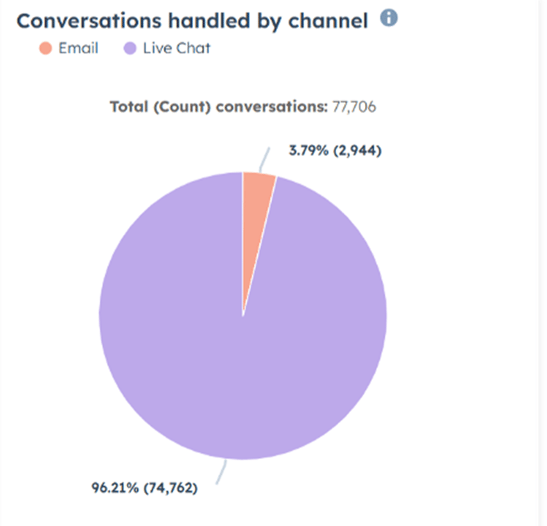
Support volume came in through multiple entry points, so the deployment covered both of the places customers actually use. Customer Agent was configured for:
- Website live chat for real-time queries
- Support email for longer-form requests and follow-ups
This let the same knowledge base and response logic serve both channels while keeping reporting clean by channel account.
2. Service Targets and Timelines
The support workflow was built around a clear time expectation so conversations did not linger. They aligned the process to:
- A 24 to 48-hour resolution target for standard requests
- A 72-hour threshold that marked a case as requiring escalation
This gave the team a consistent definition of what “on track” and “at risk” looked like.
3. Escalation, Ownership, and Alerts
Cases that crossed the escalation threshold were handled through automatic ownership assignment and notifications. When a conversation or ticket went beyond 72 hours:
- An owner was assigned
- A notification alerted the owner
- The case stayed visible until it progressed
This created a predictable safety net for edge cases and prevented silent backlog build up.
4. Handoff Flow for Complex Requests
Customer Agent handled the first pass for most conversations and routed complex requests into human assignment when required. The handoff flow was structured so:
- The conversation started with the Customer Agent assignment
- Requests requiring account-specific checks or judgment were moved to a human owner
- Context stayed attached to the conversation, so the support team did not restart from scratch
This allowed automation to cover volume while humans handled the exceptions.
5. Edge Case Coverage and Routing Rules
Edge cases were treated as a defined set of categories with clear routing behavior. Typical cases routed to humans included:
- Account-specific requests that required internal validation
- Exceptions around rules, disputes, or complaint handling
- Verification-sensitive requests
- Technical issues requiring step-by-step troubleshooting
This kept responses accurate while maintaining momentum for routine queries.
6. Knowledge Operations and Continuous Improvement
The knowledge base was maintained as a living layer connected to support performance. They used reporting signals to:
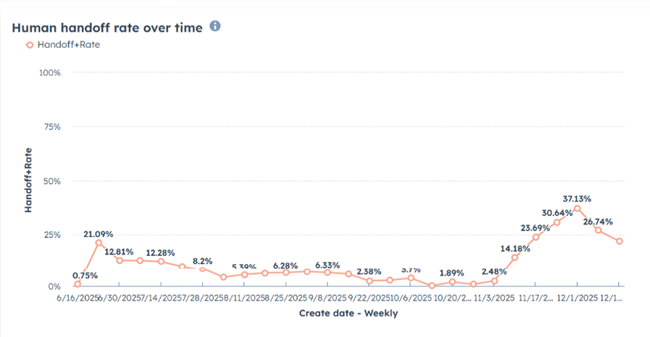
- Identify knowledge gaps from recurring queries and handoffs
- Expand or refine articles based on what customers were actually asking
- Track how changes affected handoff and resolution behavior over time
This made the system stronger as new scenarios emerged.
By combining Customer Agent across chat and email with SLA timelines, time-based escalation, and structured handoffs, The Trading Pit turned support into a repeatable system that could keep pace with volume while maintaining clear ownership for complex cases.
The Impact
Here’s what changed after The Trading Pit strengthened how HubSpot Customer Agent was deployed and supported with a deeper Knowledge Hub:
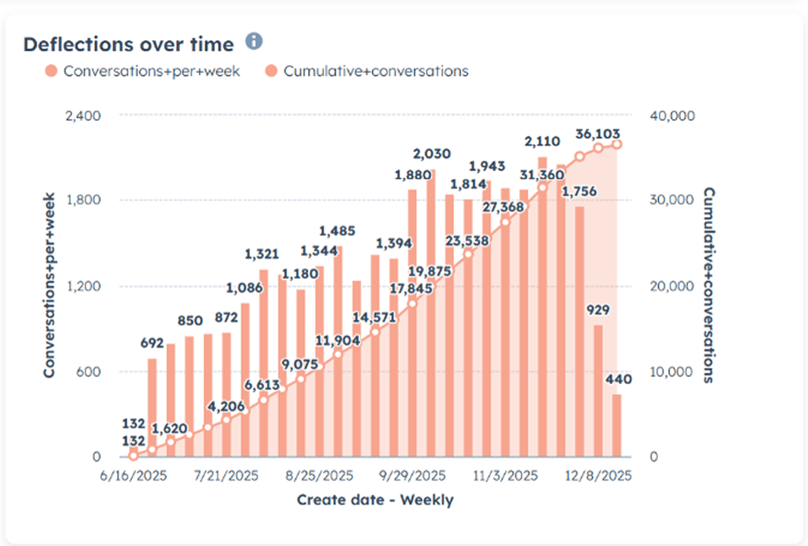
- 1,124 support conversations handled in 7 days across chat and email
- 79 percent of conversations handled without human involvement
- 96 percent of inbound demand handled through live chat, with email as a secondary channel
- 251 helpful ratings from visitors during the same period
- 24 to 48-hour resolution target became achievable for routine requests, because repetitive queries stopped entering the human queue
- Any case that crossed 72 hours triggered escalation and ownership alerts, so exceptions did not sit unattended
This happened without changing where customers reached out or how the support team operated day to day.
The focus now is on expanding knowledge coverage for edge cases, reducing unnecessary handoffs, and tightening response quality for the scenarios that still require human intervention.
Want this setup in your HubSpot portal?
Book a support automation teardown →